


Outdated data can drain the impact of even the most persuasive american sales pitch. For B2B professionals in the Netherlands, using stale information in outreach efforts leaves room for missed opportunities and wasted hours. With contact databases decaying by nearly 22.5 percent each year, staying current is more than a technical detail—it drives conversion rates and delivers measurable business gains. This guide uncovers how updated, compliant data fuels smarter lead generation and more effective cold outreach.
Table of Contents
- What Updated B2B Databases Mean Today
- Types of B2B Data and Decay Risks
- Impact on Lead Quality and Outreach Results
- Legal Compliance Requirements and Data Privacy
- Risks and Costs of Unmaintained Data
- How to Keep B2B Databases Fresh and Reliable
Key Takeaways
| Point | Details |
|---|---|
| Transformative Nature of B2B Databases | Modern B2B databases are dynamic ecosystems that enhance sales and marketing effectiveness through intelligent data integration. |
| Data Decay Management | B2B data often decays at 22.5% annually, necessitating regular audits and updates to maintain accuracy and relevance. |
| Lead Quality and Outreach | Accurate databases improve lead quality and outreach success, enabling personalized communication strategies that increase conversion rates. |
| Compliance and Data Privacy | Adhering to global data privacy regulations is essential for managing B2B databases, requiring robust governance and security measures. |
What Updated B2B Databases Mean Today
Updated B2B databases represent far more than static contact lists. Today, these sophisticated repositories have transformed into dynamic, intelligent data ecosystems designed to supercharge sales and marketing performance. Comprehensive firmographic repositories now integrate advanced technologies that enable precision targeting and strategic business intelligence.
The modern B2B database goes beyond traditional contact information, incorporating nuanced layers of data that provide unprecedented insights. These enhanced databases now include technographic details, behavioral patterns, purchasing signals, and real-time company evolution tracking. Sales professionals can access granular information about potential clients, allowing for hyper-personalized outreach strategies that dramatically improve conversion probabilities.
Key characteristics of contemporary B2B databases include real-time data validation, AI-powered enrichment, and strict compliance with international privacy regulations. Organizations can now leverage AI-integrated contact collections that automatically update and verify information, ensuring accuracy and reducing manual research time. This technological evolution means sales teams spend less time hunting for correct contact details and more time engaging qualified prospects.
Pro tip: Schedule quarterly database audits to maintain data integrity and remove outdated or irrelevant contacts, ensuring your sales team always works with the most current information.
Types of B2B Data and Decay Risks
B2B data represents a complex ecosystem of interconnected information types that power modern sales and marketing strategies. B2B data types can be categorized into several critical segments, each providing unique insights into potential business opportunities. These include identity data (basic contact information), firmographic data (comprehensive company details), technographic data (technology adoption insights), behavioral intent signals, and chronographic data tracking significant business events.
The different data types serve distinct purposes in sales intelligence. Identity data provides direct contact information, while firmographic data reveals crucial details about company size, industry, revenue, and organizational structure. Technographic data goes deeper, offering insights into the specific technologies a company uses, their digital infrastructure, and potential technology upgrade needs. Behavioral intent signals track prospect engagement, helping sales teams understand potential purchasing readiness, and chronographic data highlights critical moments like leadership changes or business expansions.
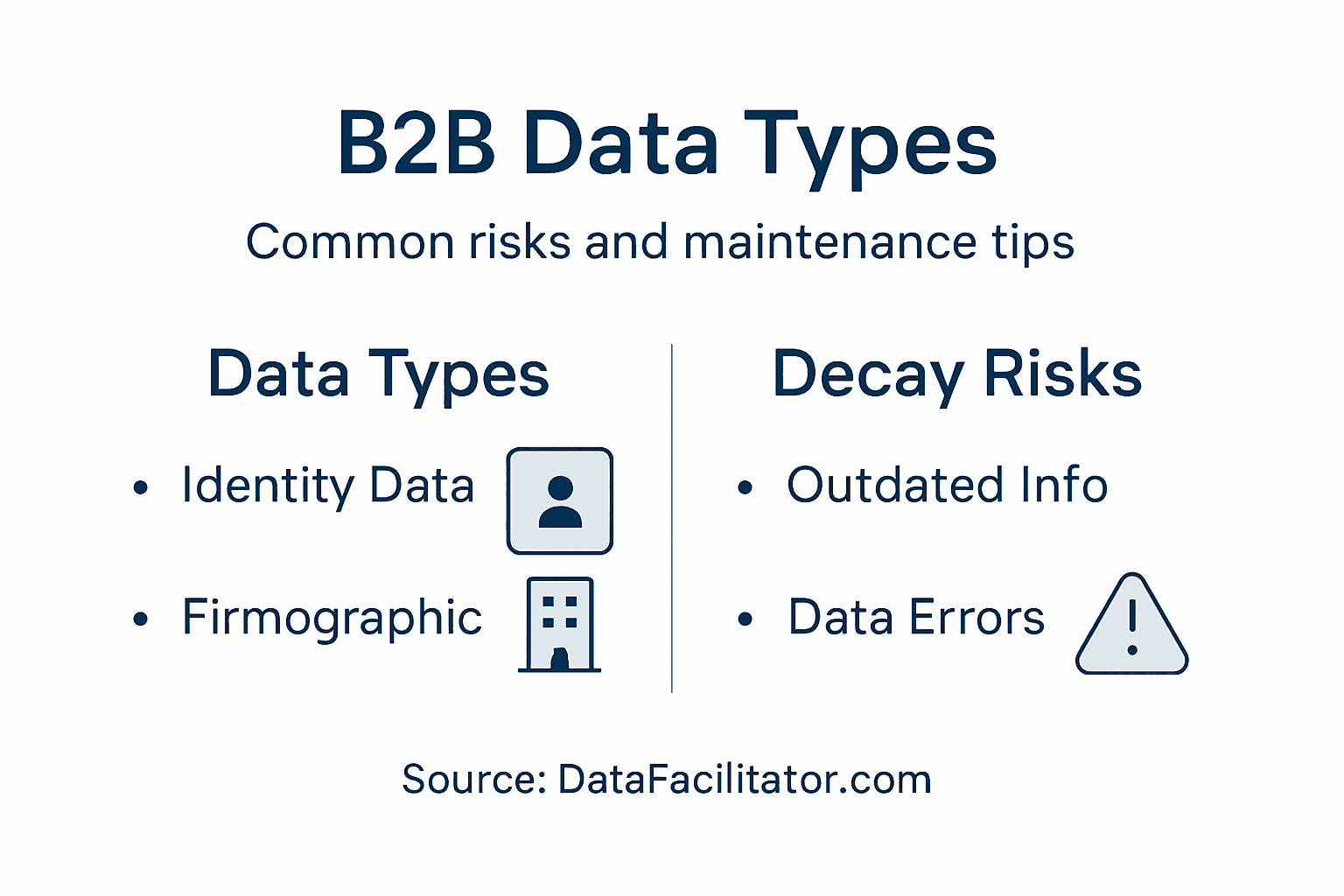
Here’s a summary of key B2B data types and their strategic contributions:
| Data Type | Description | Strategic Benefit |
|---|---|---|
| Identity Data | Basic contact details | Enables direct outreach |
| Firmographic Data | Company structure insights | Supports ideal customer profiling |
| Technographic Data | Technology use information | Reveals upgrade opportunities |
| Behavioral Signals | Tracks prospect engagement | Identifies purchase intent |
| Chronographic Data | Major company events | Spots timely outreach moments |
Data decay presents a significant challenge in maintaining B2B databases, with contact information deteriorating approximately 22.5% annually. This rapid decay occurs due to multiple factors including job changes, corporate restructuring, mergers, acquisitions, and natural business evolution. Sales teams must recognize that static databases quickly become obsolete, requiring continuous validation, updating, and enrichment to maintain their strategic value. Professional data management involves regular cleansing, cross-referencing multiple sources, and implementing automated verification processes to mitigate information degradation.
Pro tip: Implement a quarterly data refresh protocol that systematically validates and updates each contact record to minimize decay and maintain database accuracy.
Impact on Lead Quality and Outreach Results
Updated B2B databases dramatically transform lead quality by enabling more precise and strategic targeting. Machine learning lead prioritization allows sales teams to identify and concentrate on high-potential prospects with unprecedented accuracy. This technological approach moves beyond traditional lead scoring, using advanced algorithms to analyze multiple data points and predict potential conversion probabilities with remarkable precision.

The direct correlation between data accuracy and outreach performance cannot be overstated. Comprehensive, verified databases enable hyper-personalized communication strategies that significantly enhance engagement rates. Accurate lead research can improve reply and conversion rates by up to 40%, transforming cold outreach from a numbers game into a targeted, strategic approach. Sales teams can craft messages that resonate specifically with each prospect’s unique business context, technological infrastructure, and potential pain points.
Moreover, high-quality databases directly impact sender reputation and overall communication effectiveness. Reduced bounce rates, improved email deliverability, and more relevant outreach minimize the risk of being marked as spam. By ensuring contact information is current, verified, and enriched with contextual insights, organizations can create more meaningful connections. This approach transforms lead generation from a volume-based strategy to a precision-driven, relationship-building process that respects potential clients’ time and specific business needs.
Pro tip: Develop a scoring mechanism that weights leads not just by traditional metrics, but by their potential alignment with your specific solution and demonstrated technological readiness.
Legal Compliance Requirements and Data Privacy
Navigating the complex landscape of data privacy demands a comprehensive approach to B2B database management. Global privacy regulations require businesses to implement rigorous standards for personal data processing, ensuring transparency, lawfulness, and minimal data retention. The General Data Protection Regulation (GDPR) serves as a cornerstone framework, mandating that organizations demonstrate clear, valid reasons for collecting and storing contact information, with strict protocols governing data usage and protection.
Companies must develop sophisticated B2B data governance strategies that extend beyond basic compliance. This involves implementing multi-layered security measures that protect against unauthorized access, data breaches, and potential misuse. Key considerations include obtaining explicit consent, providing clear opt-out mechanisms, ensuring data minimization, and maintaining comprehensive audit trails that document every interaction with stored contact information.
The international regulatory landscape continues to evolve, with different regions implementing unique privacy requirements. While GDPR remains the most comprehensive framework, other regulations like the California Consumer Privacy Act (CCPA) and emerging data protection laws in Asia and Latin America create a complex compliance environment. Organizations must develop flexible data management approaches that can adapt to regional variations, implementing robust technological solutions that enable real-time monitoring, automatic data anonymization, and immediate response to individual data requests.
Pro tip: Create a centralized data compliance dashboard that tracks consent, retention periods, and access logs to ensure ongoing regulatory adherence across multiple jurisdictions.
Risks and Costs of Unmaintained Data
B2B organizations face significant financial and operational challenges when neglecting database maintenance. Poor data quality costs can translate into an average annual loss of $15 million, representing a substantial threat to business performance. Unmaintained databases become breeding grounds for inefficiencies that permeate multiple operational domains, from marketing outreach to strategic decision-making.
The cascading consequences of outdated data extend far beyond direct financial losses. Inaccurate contact information leads to decreased sales productivity, wasted marketing resources, and compromised communication strategies. Sales teams spend countless hours manually verifying and correcting contact details, drastically reducing their potential for meaningful client engagement. Moreover, persistently incorrect data undermines an organization’s credibility, potentially damaging hard-earned business relationships and brand reputation.
Beyond immediate operational impacts, unmaintained databases create significant compliance and strategic risks. Inaccurate data can trigger regulatory violations, expose companies to potential legal challenges, and prevent effective market segmentation. Organizations relying on stale databases miss critical market signals, fail to identify emerging opportunities, and remain perpetually one step behind more agile competitors. The opportunity cost of maintaining substandard data infrastructures can be exponentially more damaging than the direct financial losses, potentially stunting long-term business growth and market adaptability.
The table below compares outcomes of well-maintained vs. neglected B2B databases:
| Aspect | Maintained Database | Neglected Database |
|---|---|---|
| Lead Quality | Highly targeted prospects | Low relevance, low quality leads |
| Outreach Efficiency | More conversions, less effort | Wasted time on outdated contacts |
| Compliance Risk | Adheres to regulations | Elevated chance of violations |
| Revenue Impact | Drives higher sales growth | Losses due to missed opportunities |
| Brand Reputation | Builds lasting trust | Damaged credibility |
Pro tip: Establish a quarterly data audit protocol that assigns clear accountability for database maintenance, integrating automated verification tools and creating systematic processes for continuous data hygiene.
How to Keep B2B Databases Fresh and Reliable
Maintaining a robust B2B database requires a strategic, multi-dimensional approach to data hygiene practices. Organizations must implement systematic processes that go beyond simple record keeping, focusing on continuous validation, enrichment, and strategic maintenance. The goal is creating a dynamic database that evolves with market changes, providing sales and marketing teams with accurate, actionable intelligence.
Key strategies for database maintenance involve comprehensive techniques such as routine audits, deduplication, and profile enrichment. Automated validation tools play a critical role in identifying and removing outdated or incorrect information. These advanced systems cross-reference multiple data sources, flagging inconsistencies, merging duplicate entries, and ensuring that contact details remain current. Multi-source data integration enables organizations to fill profile gaps, adding depth and context to existing contact information while maintaining strict compliance with data privacy regulations.
Successful database management extends beyond technological solutions, requiring a holistic approach that combines automated tools with strategic human oversight. Sales and marketing teams should establish clear protocols for data entry, regular review cycles, and continuous learning mechanisms. This includes training staff on data quality standards, implementing strict verification processes, and creating accountability for maintaining accurate information. The most effective databases are those that balance technological efficiency with human expertise, creating a living ecosystem of business intelligence that adapts and grows with organizational needs.
Pro tip: Implement a quarterly data quality scorecard that tracks key metrics like contact accuracy, update frequency, and enrichment completeness to drive continuous database improvement.
Transform Your Sales Outreach with Updated B2B Data
Maintaining an updated B2B database is critical to overcoming common challenges such as rapid data decay, low lead quality, and compliance risks discussed in this article. Sales and marketing teams aiming to boost conversion rates and deepen personalization need highly accurate, verified contact information combined with firmographic and technographic details. This is where We handle the leads, you close the deals. – DataFacilitator can make a real difference by providing tailored, compliant datasets that empower your outbound sales efforts.
Don’t let outdated data hold back your growth. Visit DataFacilitator.com today to access scalable and transparent B2B contact lists verified through rigorous validation processes. Join countless sales teams partnering with DataFacilitator to enhance lead quality, improve outreach efficiency, and stay compliant with global data privacy regulations. Start transforming your sales pipeline now with data you can trust.
Frequently Asked Questions
What are updated B2B databases and why are they important?
Updated B2B databases are dynamic data ecosystems that provide comprehensive information beyond static contact lists. They are crucial for sales and marketing performance as they allow for precision targeting and strategic insights into potential clients.
How does data decay affect B2B databases and what can be done about it?
Data decay, which occurs at a rate of about 22.5% annually, leads to outdated contact information. To mitigate this, organizations should implement regular data validation, updating, and enrichment processes, such as quarterly audits, to maintain database accuracy.
What types of data are included in modern B2B databases?
Modern B2B databases include various data types such as identity data (basic contact info), firmographic data (company details), technographic data (technology insights), behavioral intent signals, and chronographic data (significant business events), each serving distinct purposes in sales intelligence.
How do updated B2B databases improve outreach results?
Updated B2B databases enhance outreach results by enabling hyper-personalized communication strategies. Accurate databases lead to higher engagement rates and improved conversion probabilities, allowing sales teams to craft messages tailored to each prospect’s specific needs and context.