


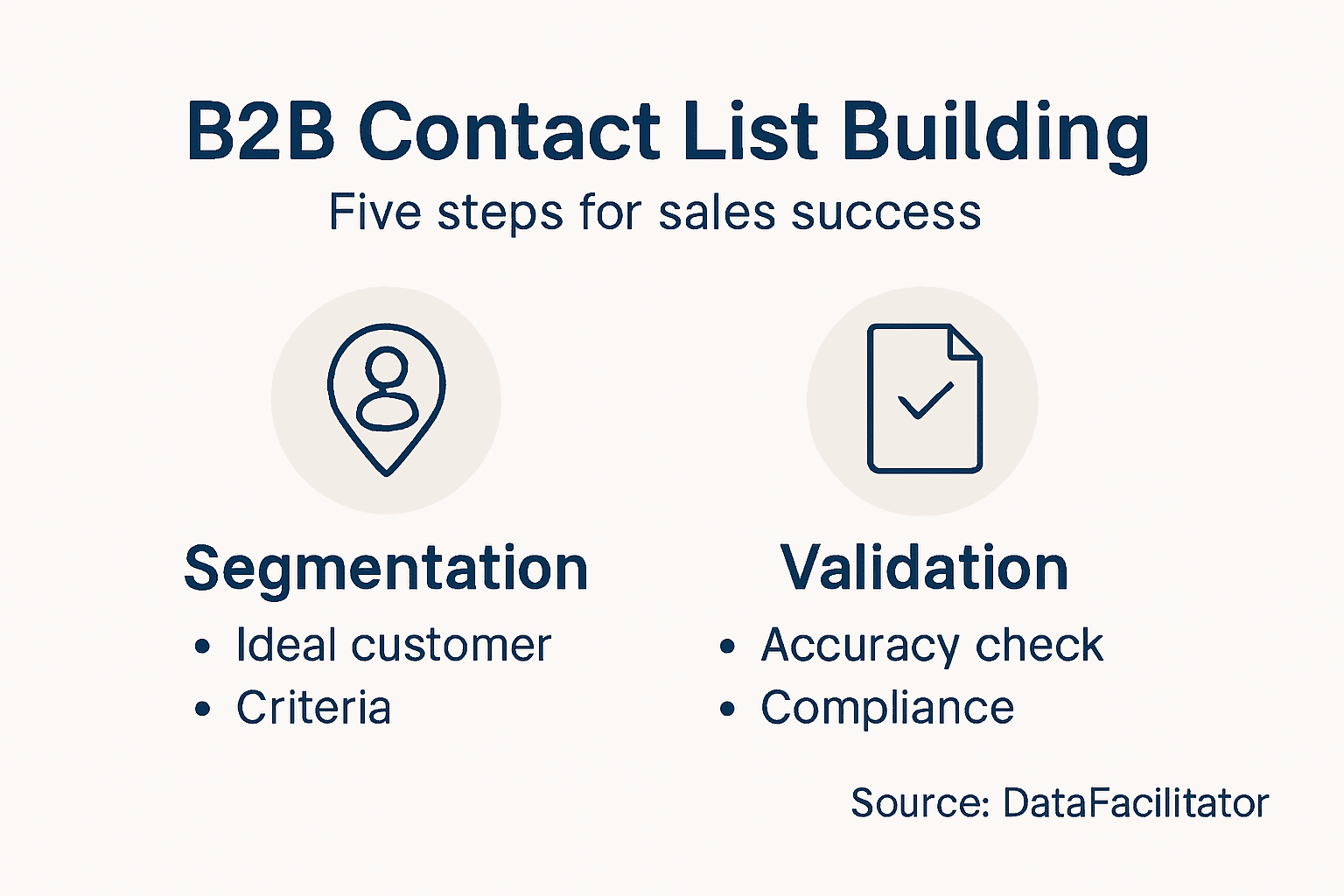
Struggling to connect with the right Dutch companies often comes down to how clearly you define your target audience. Building a compliant and effective B2B contact list is not just about collecting names but about selecting the organizations and decision makers most likely to respond. By anchoring your strategy in firmographic segmentation and behavioral insights, you can prioritize quality connections and set the stage for market expansion in the Netherlands.
Table of Contents
- Step 1: Define Your Ideal Customer And Segmentation Criteria
- Step 2: Source Relevant Company And Decision-Maker Data
- Step 3: Validate Contact Details For Accuracy And Compliance
- Step 4: Organize And Structure Your B2B Contact List
- Step 5: Verify List Quality And Prepare For Outbound Outreach
Quick Summary
| Key Insight | Explanation |
|---|---|
| 1. Define your ideal customer | Create a detailed profile based on firmographics, psychological factors, and business challenges. This ensures targeted outreach and effective segmentation. |
| 2. Source comprehensive data | Gather insights from multiple authoritative sources to enrich company and decision-maker profiles for better accuracy and prioritization. |
| 3. Validate contact information | Implement a robust verification process using multiple data points to ensure accuracy and compliance in your B2B contact list. |
| 4. Organize your contact list | Use strategic segmentation and scoring systems to categorize contacts efficiently, enhancing your targeting and outreach effectiveness. |
| 5. Prepare for targeted outreach | Develop tailored messaging and a rolling verification process to refine your contact list continually and optimize your outreach campaigns. |
Step 1: Define your ideal customer and segmentation criteria
Building targeted B2B contact lists starts with precisely defining who your most valuable potential customers actually are. This critical first step involves creating a detailed profile of companies most likely to benefit from your products or services.
Understanding B2B market segmentation requires breaking down potential customers into distinct groups based on specific characteristics. Segmenting B2B markets involves analyzing firmographic data like industry type, company size, geographic location, and purchasing behaviors. Start by mapping out the key attributes that define your ideal customer profile such as annual revenue, number of employees, technological infrastructure, and decision making hierarchy.
To refine your segmentation strategy, incorporate psychological insights into your approach. B2B customer psychological needs reveal that buyers are motivated by factors like autonomy, professional mastery, and organizational relevance. Consider creating segments not just based on demographic data but on potential business challenges, innovation appetite, and strategic goals.
Pro tip: Create a spreadsheet with 5-7 core customer segments and quantify the total addressable market size for each to prioritize your outreach strategy.
Here’s a summary of core segmentation criteria with practical application tips:
| Segmentation Type | Example Attribute | Application in B2B List Building |
|---|---|---|
| Firmographic | Number of employees | Focus outreach on medium-sized enterprises |
| Geographic | Headquarters location | Target industries in key growth markets |
| Behavioral | Recent purchases | Prioritize active technology buyers |
| Psychological | Innovation appetite | Approach companies open to new solutions |
Step 2: Source relevant company and decision-maker data
Building a powerful B2B contact list requires strategic data gathering that goes beyond basic contact information. Your goal is to collect comprehensive insights about potential companies and the key decision makers who drive their business strategies.
Start by leveraging multiple data sources to build robust company profiles. Effective B2B data collection involves combining market research reports, public business registries, professional networking platforms, and industry databases. Focus on gathering firmographic details such as company size, annual revenue, technological infrastructure, and specific industry vertical. Pay special attention to mapping out the entire buying group, understanding that purchase decisions often involve multiple stakeholders with different roles and influence levels.

To enhance your contact list quality, analyze buying group dynamics by identifying key decision makers within target organizations. Look beyond basic contact information and seek to understand each stakeholder’s professional responsibilities, potential pain points, and strategic objectives. Use professional networks like LinkedIn, industry conference attendee lists, and company websites to verify and enrich contact details for executives, managers, and key influencers who might be involved in purchasing decisions.
Pro tip: Create a standardized data verification workflow that cross references information from at least three independent sources before adding contacts to your final list.
Step 3: Validate contact details for accuracy and compliance
Ensuring the integrity of your B2B contact list requires a systematic approach to data validation that goes beyond simple verification. Your primary objective is to create a robust database of accurate and legally compliant contact information that supports successful sales outreach.
Contact data accuracy protocols demand rigorous verification processes to maintain the reliability of your contact database. Implement a multi step validation strategy that includes cross checking contact details against multiple authoritative sources such as company websites, professional networking platforms, official business registries, and industry specific directories. Pay special attention to verifying email addresses through domain authentication techniques like SMTP verification and checking for valid domain ownership. Phone numbers should be validated through real time carrier lookup services that confirm number active status and current assignment.
Expand your validation approach by implementing account verification methods that go beyond surface level checks. Use micro verification techniques like sending small verification requests or automated confirmation emails to ensure contact responsiveness. Develop a systematic process for periodic data refresh where contacts are asked to confirm or update their information every six to twelve months. This proactive approach helps maintain data quality and demonstrates your commitment to maintaining accurate business communication channels.
Pro tip: Invest in automated validation tools that can perform real time data verification and flag potentially outdated or incorrect contact information before it enters your primary database.
The following table compares key validation tools and their use in B2B contact list management:
| Tool/Method | Main Purpose | Added Value |
|---|---|---|
| Email verification system | Check deliverability and domain | Reduces bounce rates and errors |
| Carrier lookup service | Confirm phone number status | Ensures numbers are current |
| Automated cross-referencing | Compare data across sources | Flags inconsistencies proactively |
| Micro verification emails | Confirm contact responsiveness | Keeps records up-to-date and active |
Step 4: Organize and structure your B2B contact list
Creating an effective B2B contact list requires more than just collecting information. You need a strategic approach that transforms raw data into a powerful sales asset that drives targeted outreach and relationship management.
Advanced contact management systems enable sales teams to categorize contacts with precision and depth. Develop a comprehensive taxonomy that segments contacts across multiple dimensions including company size, industry vertical, engagement history, purchase potential, and decision making authority. Create hierarchical tags that allow granular filtering such as company revenue brackets, technological infrastructure, geographic region, and specific business challenges. Use a consistent tagging system that allows quick retrieval and intelligent routing of contact information.
Implement a scoring mechanism that ranks contacts based on their potential value and likelihood of conversion. Assign numerical scores for factors like previous interaction quality, responsiveness to communications, budget indicators, and strategic alignment with your product offerings. Configure your contact management system to automatically update these scores based on ongoing interactions and behavioral signals. This dynamic approach ensures your sales team always focuses energy on the most promising prospects while maintaining a comprehensive view of your entire potential market.
Pro tip: Design your contact list structure with flexibility in mind and regularly audit your categorization system to ensure it remains aligned with evolving business objectives and market dynamics.
Step 5: Verify list quality and prepare for outbound outreach
Building a high-performing B2B contact list requires rigorous verification and strategic preparation before launching any sales campaign. Your goal is to transform raw contact data into a precisely targeted outreach arsenal that maximizes engagement potential.
B2B lead generation strategies emphasize continuous data refinement and quality assessment. Develop a comprehensive verification checklist that evaluates each contact across multiple dimensions including email deliverability, phone number accuracy, job role currency, and company information completeness. Implement automated validation processes that flag incomplete or potentially outdated records, ensuring your team focuses only on high potential prospects. Cross reference contact information against multiple authoritative sources and remove any entries with significant data gaps or inconsistencies.
Prepare your contact list for targeted outreach by developing segment specific messaging frameworks that align with different buyer personas and industry verticals. Create tailored communication templates that reflect the unique challenges and priorities of each contact group. Configure your outreach tools to support personalized communication at scale, enabling your sales team to deploy precise messaging that resonates with specific audience segments. This strategic approach transforms your contact list from a simple database into a dynamic sales acceleration tool.
Pro tip: Implement a rolling verification process where contact data is systematically reviewed and updated every 90 days to maintain list integrity and maximize outreach effectiveness.
Unlock Targeted Sales Success with Verified B2B Contact Lists
Building precise B2B contact lists requires more than just collecting data. You need accurate segmentation, deep insights into decision-makers, and validated contacts to power effective outreach. If crafting detailed customer profiles and maintaining data accuracy feels overwhelming, DataFacilitator.com offers a clear solution. We specialize in delivering highly targeted and compliant B2B lead lists designed to fit your ideal customer segments and outreach goals.
We handle the leads, you close the deals. – DataFacilitator
Every contact in our database is carefully verified using multi-source validation to ensure you connect with real decision-makers ready for your message. Our pay-per-result model means you only pay for leads delivered so you avoid wasting resources on outdated or irrelevant data. With coverage across industries and regions, you get the flexibility and confidence to grow your outbound sales pipeline effectively.
Explore tailored B2B lead solutions
Take the next step to transform your sales outreach today and experience how verified, well-segmented contact lists accelerate your sales success. Visit DataFacilitator.com and get started with data that truly drives conversions now.
Frequently Asked Questions
How do I define my ideal customer for building a B2B contact list?
To define your ideal customer, create a detailed profile that includes key attributes like annual revenue, company size, and industry type. Map out these characteristics to identify distinct segments that will benefit from your products or services.
What data sources should I use to source company and decision-maker information?
Leverage a mix of market research reports, professional networking platforms, and public business registries to gather comprehensive insights. Focus on acquiring firmographic data and understanding the roles of key decision-makers involved in purchasing decisions.
How can I validate the accuracy of my B2B contact list?
Implement a multi-step validation process that includes cross-checking contact details against multiple authoritative sources. Regularly verify email addresses and phone numbers to ensure they are active and accurate, aiming for a verification cycle every 90 days.
What steps can I take to organize and structure my B2B contact list effectively?
Develop a comprehensive tagging system that segments contacts based on company size, engagement history, and purchasing potential. Create a scoring mechanism to rank contacts based on their likelihood of conversion, allowing your sales team to prioritize the most promising leads.
How should I prepare my contact list for effective outbound outreach?
Create a verification checklist assessing each contact’s completeness and accuracy before launching outreach campaigns. Tailor your messaging to different audience segments by developing specific communication templates that address their unique challenges and priorities.
What is the importance of psychological factors in B2B contact list segmentation?
Incorporating psychological insights into your segmentation strategy helps address B2B customers’ motivations, like autonomy and innovation appetite. Create segments based on these factors to better align your outreach efforts with their specific business challenges and strategic goals.
Recommended
- 7 Must-Have Steps for a Winning B2B Outreach Checklist – DataFacilitator
- B2B Lead Sources: Maximizing Sales Outreach Impact – DataFacilitator
- Why Update B2B Databases: Boosting Sales Results – DataFacilitator
- B2B Cold Leads: Verified Data & Outreach Insights – DataFacilitator
- How to Increase Sales Through Digital Marketing Strategies - Paul Baguley