


Every Sales and Marketing Manager knows the frustration of reaching out to companies that simply are not a fit. For B2B tech teams in the Netherlands, building a compliant and targeted prospect list means more than collecting names — it is about connecting with organizations that actually match your solution’s value. By focusing on a data-driven Ideal Customer Profile (ICP), you can optimize every step of your outreach and maximize your conversion potential.
Table of Contents
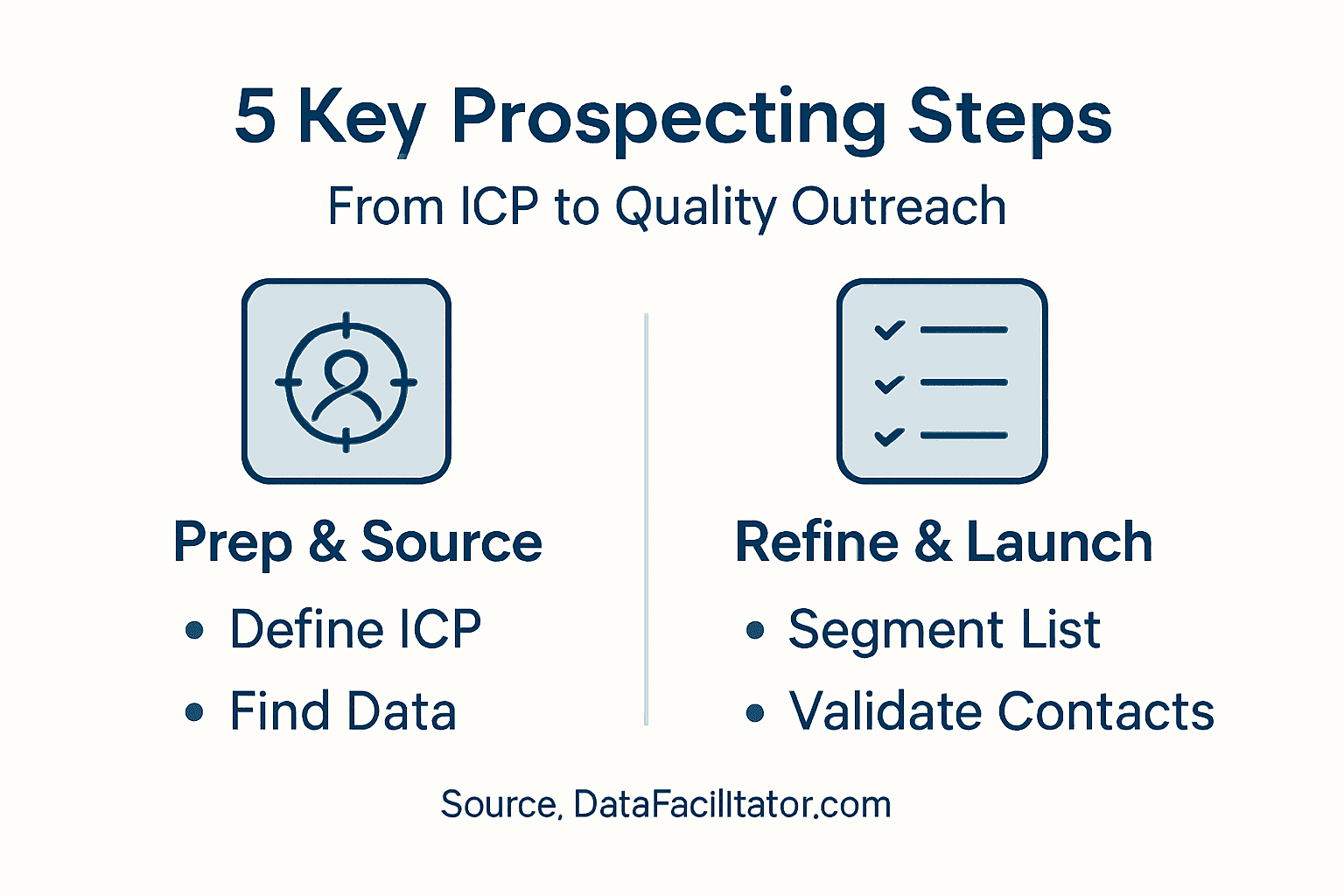
- Step 1: Define Ideal Prospect Criteria Based On Market Needs
- Step 2: Source Targeted Company Data Using Reliable Platforms
- Step 3: Segment And Refine Prospects For Relevance And Compliance
- Step 4: Validate Contact Details To Ensure Accuracy
- Step 5: Export And Format Lists For Outreach Campaigns
Quick Summary
| Key Insight | Explanation |
|---|---|
| 1. Define Ideal Customer Profile | Analyze attributes like budget, needs, and authority to identify promising prospects. |
| 2. Source Reliable Company Data | Use verified platforms to gather accurate business intelligence for prospecting. |
| 3. Segment for Targeted Outreach | Break down prospects by key criteria for personalized communication strategies. |
| 4. Validate Contact Information | Ensure accuracy through multi-step verification processes to maintain list integrity. |
| 5. Export and Format Lists Properly | Finalize data for seamless integration with outreach platforms to enhance marketing efforts. |
Step 1: Define ideal prospect criteria based on market needs
Building effective B2B prospect lists starts with understanding precisely who represents your most promising potential customers. The goal is to create a data-driven profile that matches your product or service with companies most likely to benefit and convert.
To develop an accurate Ideal Customer Profile (ICP), you need to analyze multiple dimensions of potential prospects. Sales qualification criteria typically involve examining key attributes like budget capacity, decision making authority, specific business needs, purchasing timeline, and overall organizational fit. This means going beyond basic demographics and diving deep into behavioral and strategic characteristics that indicate genuine potential.
Start by mapping out your current successful customer base to identify common attributes. Look for patterns in company size, industry vertical, technological infrastructure, growth stage, and specific pain points your solution addresses. Gartner recommends compiling both quantitative data (revenue ranges, employee count, technological investments) and qualitative insights (organizational culture, strategic priorities) to create a comprehensive prospect profile.
Pro Tip: Regularly update your ICP every six months to ensure your targeting remains aligned with evolving market dynamics and your product’s changing capabilities.
Here’s a summary of key criteria for building an Ideal Customer Profile (ICP):
| Criteria Type | Example Attributes | Value to Prospecting |
|---|---|---|
| Quantitative | Revenue, employee count | Enables targeted outreach |
| Qualitative | Strategic priorities, culture | Improves prospect relevance |
| Behavioral | Purchasing timeline, needs | Identifies ready prospects |
| Technological | Infrastructure investments | Assesses product compatibility |
Step 2: Source targeted company data using reliable platforms
Sourced company data forms the foundation of any successful B2B outreach strategy. Your goal is to collect comprehensive, accurate information from platforms that provide verified and actionable business intelligence.
When searching for reliable data sources, focus on platforms offering high-quality market research datasets that provide structured and compliant information. These platforms should offer detailed company profiles including key details like industry vertical, company size, revenue ranges, technological infrastructure, and contact information for decision makers. Government databases, nonprofit organizations, academic research centers, and specialized B2B data providers can serve as excellent repositories for targeted company information.
Begin by evaluating potential data platforms based on their coverage, accuracy, update frequency, and compliance with data protection regulations. Look for sources that offer real time verification, cross referenced information, and transparent data collection methodologies. Prioritize platforms that provide not just contact information, but contextual insights about potential prospects that can help you craft more personalized outreach strategies.
Pro Tip: Cross reference data from multiple sources to ensure maximum accuracy and reduce the risk of outdated or incorrect business information.
Compare the main B2B data sourcing options for prospect lists:
| Source Type | Coverage Strength | Compliance Considerations |
|---|---|---|
| Specialized platforms | High, industry-specific | Usually strong, subject to audits |
| Government databases | Broad, official | Regulated and transparent |
| Academic centers | Niche, research-heavy | Varies, typically robust |
| Nonprofits | Specific segments | Often compliant, limited scope |
Step 3: Segment and refine prospects for relevance and compliance
Refining your prospect list requires strategic segmentation that transforms raw data into targeted marketing opportunities. Your objective is to create precise prospect groups that maximize outreach potential while maintaining strict data privacy standards.

Prospect segmentation involves carefully analyzing demographic and behavioral characteristics to create meaningful business categories. Break down your initial prospect database using criteria like industry vertical, company size, revenue range, technological infrastructure, geographic location, and decision maker roles. This granular approach allows you to craft personalized communication strategies that resonate with specific business segments.
Prioritize compliance throughout your segmentation process by implementing rigorous data protection protocols. Verify that your prospect lists adhere to regulations like GDPR, ensuring you have legitimate reasons for contact and maintaining transparent opt out mechanisms. Focus on quality over quantity by eliminating outdated contacts, removing duplicates, and cross referencing information to maintain a clean, actionable prospect database that supports effective and ethical outreach efforts.
Pro Tip: Develop a systematic scoring mechanism that automatically ranks prospects based on their alignment with your ideal customer profile, enabling more efficient targeting and resource allocation.
Step 4: Validate contact details to ensure accuracy
Contact validation is a critical step in building a reliable B2B prospect list. Your goal is to eliminate incorrect, outdated, or irrelevant contact information that could compromise your outreach effectiveness and waste valuable marketing resources.
Advanced AI technologies help verify contact accuracy with unprecedented precision. Implement a multi-step validation process that includes email verification, phone number confirmation, checking corporate website references, and cross referencing social media professional profiles. Look for real time verification tools that can ping email servers, validate domain existence, and confirm active email accounts without sending actual marketing communications.
Develop a systematic approach to contact validation that combines automated verification with manual spot checking. Prioritize recent data sources, eliminate contacts with bounced emails or disconnected phone numbers, and continuously update your database to maintain high quality standards. Focus on gathering verified direct contact information for decision makers rather than generic company contact points, which increases your chances of meaningful business engagement.
Pro Tip: Create a quarterly data hygiene protocol that automatically removes contacts with more than two consecutive communication failures to maintain list integrity.
Step 5: Export and format lists for outreach campaigns
Transforming your meticulously curated prospect list into an actionable format is crucial for successful B2B outreach. Your goal is to prepare data that integrates seamlessly with marketing automation platforms and communication tools.
Outreach platforms provide robust export functions for downloading prospect lists as CSV files. When exporting, ensure your file includes essential fields such as first name, last name, company name, email address, phone number, job title, and any relevant interaction history. Standardize your data formatting to maintain consistency across different columns and eliminate special characters that might cause import errors.
Prepare your exported file by performing a final data cleansing pass. Remove duplicate entries, verify column headers are clear and consistent, and confirm that all contact information follows a uniform format. Consider creating separate columns for additional segmentation details like industry vertical, company size, or previous engagement metrics to enable more targeted future campaigns.
Pro Tip: Always create a backup of your original prospect list before making any export or formatting modifications to prevent accidental data loss.
Elevate Your B2B Outreach with Precision-Targeted Prospect Lists
Building effective B2B prospect lists can feel overwhelming when you are challenged by inaccurate data, compliance issues, and the need for deeply segmented targeting. This article highlights the importance of creating an Ideal Customer Profile, sourcing verified company data, and validating contacts—essential steps that often demand time and careful resources.
DataFacilitator.com simplifies these hurdles by providing highly targeted and compliant B2B contact lists crafted for outbound sales and cold outreach. Our proven approach delivers verified leads tailored by country, region, and industry, ensuring you connect with prospects who truly match your ideal profile. Experience the benefit of reduced outreach waste and higher conversion potential when you leverage our data services designed for your sales success.
Explore how we handle the leads so you can focus on closing deals with our specialized B2B leads collections.
Unlock the power of accurate data now by visiting DataFacilitator.com. Take control of your cold outreach with confidence and start converting prospects who matter today. Discover more or get started instantly at our frontpage collections.
Frequently Asked Questions
What criteria should I use to define my Ideal Customer Profile for B2B prospect lists?
To define your Ideal Customer Profile, analyze key attributes such as budget capacity, decision-making authority, and specific business needs. Map out your current successful customer base to identify trends in company size, industry, and pain points.
How do I source reliable company data for building my B2B prospect list?
Use platforms that offer high-quality market research datasets, focusing on those with verified company profiles and accurate contact information. Evaluate data sources based on their coverage, accuracy, and compliance with data protection regulations, aiming for real-time verification.
What are the best practices for segmenting my prospect database?
Segment your prospect database by analyzing characteristics like industry vertical, company size, and decision-maker roles. This targeted approach enables you to craft personalized communication strategies that resonate with each specific segment.
How can I validate contact details to ensure the accuracy of my prospect list?
Implement a multi-step validation process that includes email verification and cross-referencing social media profiles. Make sure to eliminate contacts with bounced emails or disconnected phone numbers to maintain high-quality standards in your list.
What should I include when exporting my prospect lists for outreach campaigns?
Ensure your exported list includes essential fields such as first name, last name, company name, email address, and job title. Standardize formatting and remove duplicates to create a clean and actionable prospect list for your outreach efforts.