


Sales teams in Europe know the frustration of cold outreach gone wrong when generic data leads to bounced emails and missed decision-makers. The difference between wasted effort and qualified conversations often comes down to the quality of your outbound contact lists. Understanding the truth behind B2B data helps you avoid common pitfalls, spot high-value opportunities, and carry out outreach confidently within compliance rules. Discover how factual, structured business data can transform market analysis and lead generation for European professionals.
Table of Contents
- B2B Data Defined And Common Misconceptions
- Types Of B2B Data For Sales And Outreach
- How B2B Data Powers Real-World Applications
- Ensuring Data Compliance And Legal Safety
- Risks Of Poor Data And Quality Solutions
Key Takeaways
| Point | Details |
|---|---|
| Value of B2B Data | B2B data is essential for strategic decision-making, focusing on company-level details rather than individual profiles. |
| Importance of Data Quality | High-quality B2B data must be structured and verified to ensure effective outreach and compliance with regulations. |
| Types of B2B Data | Different data types like contact, firmographic, and technographic data serve specific roles in enhancing sales strategies. |
| Legal Compliance | Understanding data privacy regulations like GDPR is crucial to avoid legal risks and maintain a good business reputation. |
B2B Data Defined and Common Misconceptions
B2B data represents the factual information that businesses exchange and leverage to drive sales, marketing, and strategic decision-making. Unlike B2C data focused on individual consumer profiles and behaviors, B2B data encompasses company-level details such as industry classification, employee count, annual revenue, location, and decision-maker contact information. Think of it as the operational blueprint of a company rather than a portrait of a single person. This fundamental distinction shapes how sales teams approach lead generation, market research, and customer outreach strategies.
One widespread misconception is that B2B data simply means having a list of company names and email addresses. In reality, high-quality B2B data requires structured, verified information organized by specific attributes. A European sales team targeting mid-market software companies in France, for example, needs more than generic contact records. They need verified company financials, accurate decision-maker names with current job titles, legitimate phone numbers, and validated email addresses that reflect actual business operations. Another common mistake is treating all B2B data providers as equivalent. Many platforms deliver outdated contact lists compiled months ago, while others maintain continuously updated databases that reflect actual business changes, hiring patterns, and organizational restructuring.
B2B data also divides into two categories that serve different purposes. Internal data originates from your own company systems including customer records, sales pipeline data, and previous campaign performance metrics. External data comes from third-party sources and public databases, providing market intelligence about companies you haven’t yet engaged. Knowing which data type answers which business question prevents wasted effort. If you’re analyzing your own conversion rates, internal data suffices. If you’re identifying untapped market segments or expanding into new regions across Europe, external verified data becomes essential. The distinction matters because compliance requirements, data rights, and strategic applications differ between the two.
Pro tip: Before committing budget to any B2B data source, request a sample dataset with current contact records and ask for verification details such as how recently the information was validated and what sources were used to compile it.
Types of B2B Data for Sales and Outreach
Sales and marketing teams need multiple data types working together to execute effective outreach campaigns. Contact Data forms the foundation, providing names, titles, email addresses, and phone numbers of actual decision-makers within target companies. Without accurate contact data, your outreach lands in the void or reaches the wrong person entirely. Firmographic Data describes the company itself: industry vertical, employee count, annual revenue, location, and company structure. When you combine contact data with firmographic details, you can craft highly relevant messaging. A sales development representative reaching out to a finance director at a 500-person B2B SaaS company needs fundamentally different messaging than one contacting the same role at a 50-person startup.
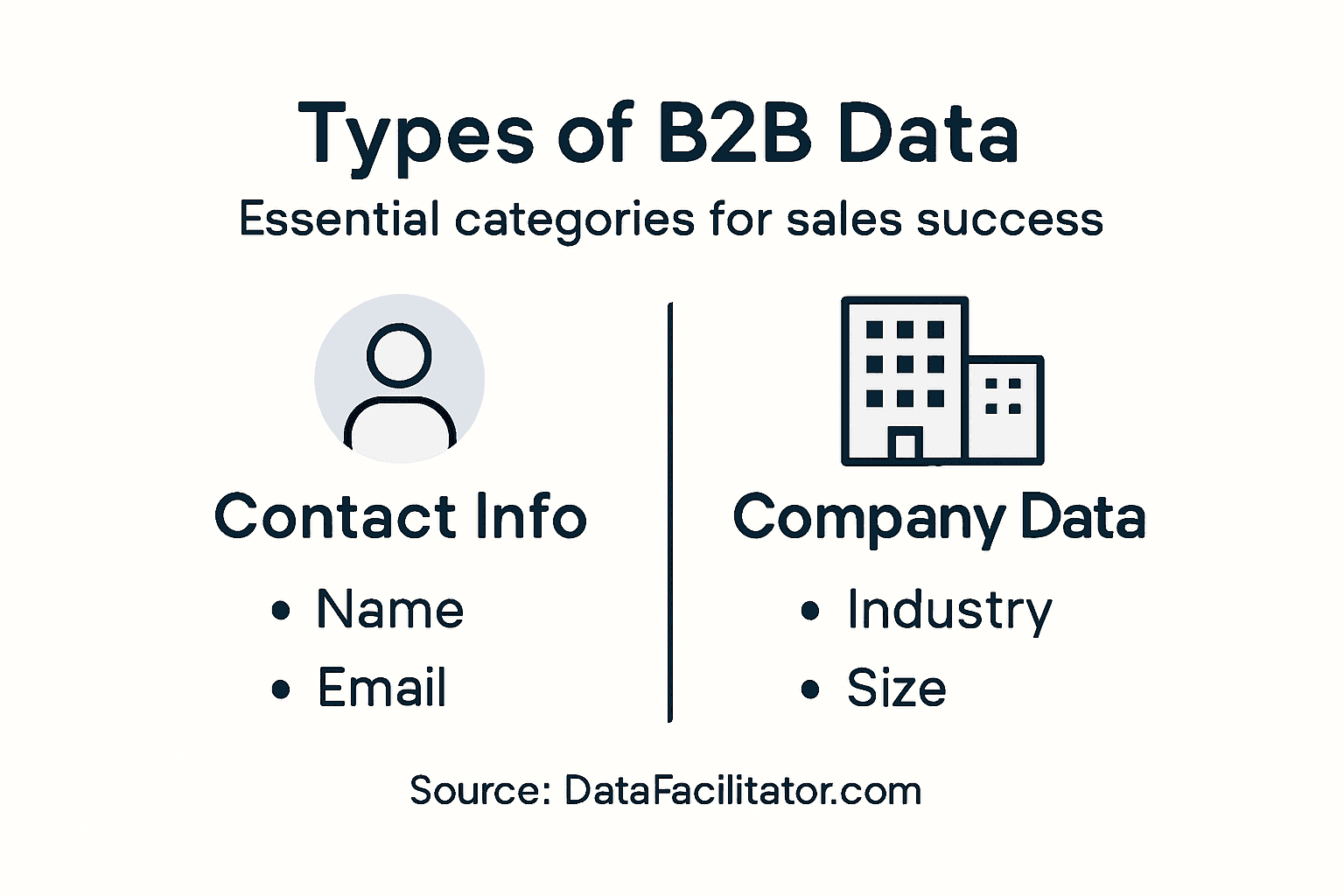
Technographic Data reveals what technology stack a company uses, which matters significantly for software and service providers. If you sell an integration platform, knowing whether your prospect uses Salesforce, HubSpot, or Pipedrive changes your entire pitch. Intent Data and engagement signals indicate when a company shows buying signals, such as visiting your website multiple times, downloading resources, or engaging with your content on LinkedIn. Chronographic Data captures event-based information like leadership changes, funding announcements, or product launches that create sales opportunities. These events often signal that a company is actively making purchasing decisions or restructuring operations, making them ideal times for outreach. A new Chief Marketing Officer typically means budget discussions are happening, making it the perfect moment to present relevant solutions.
Each data type answers a specific question in your sales process. Contact data answers “Who do I reach?” Firmographic data answers “Is this company a fit?” Technographic data answers “What solutions matter to them?” Intent and engagement data answer “When should I reach out?” The most successful European sales teams don’t rely on one data type alone. Instead, they layer these together. You identify companies in your target industry and size (firmographic), verify they use complementary technology (technographic), locate the right decision-makers (contact), and monitor when they show buying signals (intent) before launching outreach campaigns. This layered approach dramatically improves conversion rates compared to generic mass outreach.
Pro tip: Prioritize contact data accuracy above all other data types because even the most sophisticated firmographic or intent signals become worthless if your email bounces or your call reaches a wrong department.
Here’s a summary comparing the main types of B2B data and their core business value:
| Data Type | Key Attribute | Answers Which Sales Question | Typical Business Impact |
|---|---|---|---|
| Contact Data | Decision-maker details | Who do I reach? | Increased outreach accuracy |
| Firmographic Data | Company size, industry, location | Is this company a fit? | Improved targeting and segmentation |
| Technographic Data | Technology stack info | What solutions matter to target? | Enables tailored solution-based pitches |
| Intent Data | Buying signals, engagement | When should I reach out? | Higher conversion timing and relevance |
| Chronographic Data | Company events and changes | Are there timely opportunities? | Captures new sales chances |
How B2B Data Powers Real-World Applications
B2B data transforms from raw information into competitive advantage when applied strategically across your sales operations. Consider a typical scenario: your team has 200 qualified leads but needs to prioritize outreach. Without quality B2B data, you contact them in random order, wasting weeks reaching people who lack buying authority or companies operating outside your target market. With segmented, accurate B2B data, you immediately identify which prospects fit your ideal customer profile, contact the actual decision-makers, and time your outreach around company events like funding rounds or leadership changes. The difference is dramatic. Teams using B2B data for targeted prospecting report higher engagement rates, shorter sales cycles, and better conversion outcomes compared to those relying on generic contact lists.
Sales development representatives use B2B data daily to research prospects before reaching out. Instead of making cold calls to random numbers, they access verified decision-maker information, understand company structure and recent news, and identify technology platforms the prospect already uses. This research transforms a generic pitch into a personalized conversation. A business development manager at a European marketing agency can review a prospect’s employee count, recent job postings, industry classification, and website technology stack in minutes, then craft messaging that speaks directly to their challenges. Accuracy matters intensely here because outdated contact information, incorrect titles, or wrong department assignments result in wasted outreach and damaged reputation. Your first impression counts, and reaching the wrong person or using stale information kills credibility instantly.
Marketing teams leverage B2B data to execute data-driven campaigns that segment audiences by company characteristics, geography, industry, and buying behavior. Rather than sending the same email to all prospects, they develop targeted campaigns for specific segments. A campaign targeting technology directors at software companies differs entirely from one targeting procurement managers at manufacturing firms. B2B data enables this precision segmentation. Campaign performance improves dramatically when messaging aligns with actual audience characteristics and challenges. Additionally, customer relationship management systems powered by accurate B2B data help sales teams track interactions, identify patterns in successful deals, and forecast revenue more reliably. Teams with clean, current B2B data in their CRM systems close deals faster because they understand their customer base deeply and can identify ideal customer profiles for replication.
Pro tip: Before launching any outreach campaign, cross-reference your contact data against current company information to identify role changes, company location updates, or mergers that might invalidate your targeting assumptions.
Ensuring Data Compliance and Legal Safety
Operating with B2B data across European markets means navigating a complex regulatory environment where mistakes carry serious consequences. The General Data Protection Regulation (GDPR) applies to any organization handling personal data of individuals within the European Union, regardless of where your company operates. If you are using B2B contact lists containing email addresses and phone numbers of business professionals in Germany, France, or any EU member state, GDPR applies to you. Similarly, if you are expanding into North America, the California Consumer Privacy Act (CCPA) and other regional regulations impose additional requirements. These frameworks exist to protect individuals, but they also create legal obligations that sales and marketing teams must understand and respect. Data privacy laws like GDPR require organizations to maintain informed consent, handle personal data securely, and respect data subject rights such as the right to access and the right to be forgotten.
Compliance begins with choosing the right B2B data provider. Not all data providers operate with the same standards. Some maintain outdated lists compiled years ago without permission verification. Others actively validate data sources, obtain proper consent from contacts, and maintain documentation proving compliance. When evaluating a B2B data provider, ask specific questions: How do they source contact information? Do they have consent from data subjects for their inclusion in the database? How frequently do they update records to remove people who have opted out? Can they provide evidence of compliance with GDPR and other applicable regulations? DataFacilitator, for instance, emphasizes transparency by providing screen recordings of data before delivery and operating on a pay-per-result model where you only pay for verified leads. This approach reduces risk because you are purchasing validated, compliant data rather than betting on generic lists.
Implementing robust data governance within your own organization protects you further. Store B2B contact data securely with access controls limiting who can view sensitive information. Maintain detailed records documenting your legal basis for processing each contact, whether that is legitimate business interest, consent, or contractual necessity. Implement data cleaning procedures to remove duplicate records, outdated contacts, and individuals who have requested removal from your outreach. Regular audits of your B2B databases catch compliance gaps before they become problems. Train your sales and marketing teams on data handling practices. Your entire team must understand that sending unsolicited outreach to people who have explicitly opted out constitutes a violation, regardless of how good your sales pitch might be. This is not just legal protection, it is also practical business sense because reputation damage from compliance violations far exceeds any short-term sales gains.
Pro tip: Request compliance documentation from any B2B data provider before purchase, specifically asking whether they can demonstrate GDPR compliance and provide audit trails showing data source verification and consent management.
Below is a quick reference guide to common B2B data compliance frameworks and what each requires:
| Regulation | Primary Region | Key Requirement | Impact on B2B Data Handling |
|---|---|---|---|
| GDPR | European Union | Informed consent, right to remove | Must validate data and consent |
| CCPA | California, USA | Data access, opt-out options | Maintain removal and audit trails |
| Local EU Laws | Individual nations | Possible additional restrictions | Adapt processes for each market |
Risks of Poor Data and Quality Solutions
Poor quality B2B data creates a cascade of problems that damage revenue, efficiency, and reputation. When your contact lists contain outdated information, incorrect email addresses, or wrong decision-maker names, your sales team wastes enormous amounts of time chasing dead ends. An email bounces. A phone number routes to someone who left the company six months ago. A title is wrong, so your message lands with someone lacking budget authority. These individual failures compound across hundreds of outreach attempts, resulting in severely depressed response rates and wasted marketing spend. A sales development representative spending two hours daily correcting bad data loses productivity that could have generated qualified conversations. Multiply this across a team of ten representatives, and you are losing the equivalent of multiple full-time positions annually. Beyond direct productivity loss, poor data damages your sender reputation. Email providers track bounce rates and spam complaints. When your campaigns consistently bounce or get marked as spam, email providers throttle or block future messages from your domain. Recovery from a damaged sender reputation takes months and costs significantly more than maintaining good data from the start.

Incorrect or stale B2B data also creates serious compliance risk. If you send outreach to someone who has opted out, whether because you lack current information or because the data provider failed to maintain accurate opt-out records, you violate GDPR and face regulatory fines. The European Union does not interpret these violations leniently. Individual instances can result in fines reaching thousands of dollars, and patterns of violations invite regulatory investigations that extend beyond financial penalties to reputational damage and restrictions on future data processing activities. Poor data compounds this risk because you cannot demonstrate your compliance efforts if your foundational data quality is questionable.
Quality solutions address these risks directly. The most effective approach involves partnering with B2B data providers who maintain continuously updated databases with active validation processes. Rather than purchasing a static list once and hoping it remains accurate, quality providers verify contact information regularly, monitor for role changes and company updates, and maintain clear audit trails documenting their validation methods. Pay-per-result models align incentives properly because the provider only profits when they deliver accurate, qualified leads. This contrasts sharply with traditional list providers who profit regardless of whether their data works. Additionally, implement internal data quality practices. Regular database audits identify and remove duplicates, outdated records, and contacts who have opted out. Assign clear ownership of data quality to someone on your team rather than treating it as an afterthought. Modern sales teams recognize that data quality directly determines sales outcomes, so they invest accordingly.
Pro tip: Test any new B2B data source with a small pilot campaign before committing significant budget, tracking bounce rates and response rates to verify the quality claims before scaling deployment.
Unlock the Power of Accurate B2B Data for Your Sales Success
If you have been struggling with outdated contact information or unreliable leads as highlighted in the article “What Is B2B Data and Why Accuracy Matters” you know how critical precise and validated data is to successful outbound sales and cold outreach. Common pain points include wasting time chasing the wrong contacts, low response rates caused by stale or incorrect details, and the headache of ensuring GDPR compliance. These challenges make it clear that trustworthy and up-to-date B2B data is not just helpful but essential to boost conversion and outreach effectiveness.
At DataFacilitator.com, we specialize in delivering highly targeted, verified B2B contact lists tailored to your specific regions and industries. Our platform stands apart because we validate data continuously and transparently by providing screen recordings of data verification before you even buy. Plus, our pay-per-result model ensures you only pay for actual, qualified leads. You can explore our comprehensive selection of accurate leads at We handle the leads, you close the deals – DataFacilitator or browse various options on our frontpage collection.
Stop letting poor data hold your sales team back and start targeting the right decision-makers with up-to-the-minute firmographic and contact details. Visit https://datafacilitator.com now to secure compliant, verified B2B data and take control of your outreach with confidence and precision.
Frequently Asked Questions
What is B2B data?
B2B data refers to facts and information that businesses exchange to enhance sales, marketing, and strategic decisions about other companies, focusing on company-level details rather than individual consumer profiles.
Why is accuracy important in B2B data?
Accuracy in B2B data is crucial because it directly impacts outreach effectiveness, ensuring that sales teams contact the right decision-makers and avoid wasting time on outdated or incorrect information.
What types of B2B data are essential for effective sales outreach?
Key types of B2B data include contact data, firmographic data, technographic data, intent data, and chronographic data, each serving different purposes in the sales process and improving targeted outreach.
How does poor quality B2B data affect a company’s performance?
Poor quality B2B data can lead to wasted time and resources, lower response rates, damaged sender reputation, and potential compliance risks, ultimately harming revenue and efficiency.