


Every sales manager knows the challenge of finding quality leads that actually convert. For B2B sales teams in the Netherlands, attracting and qualifying the right prospects means focusing on decision-makers, understanding unique buyer journeys, and applying strategies that fit longer sales cycles. By mastering targeted lead generation and personalizing cold outreach, your team can fill the pipeline with high-potential business customers who drive real growth.
Table of Contents
- Defining B2B Lead Generation for Sales Teams
- Key Types and Methods for B2B Leads
- How the B2B Lead Generation Process Works
- Legal Compliance and Data Validation Essentials
- Common Pitfalls and Maximizing Cold Outreach
Key Takeaways
| Point | Details |
|---|---|
| B2B Lead Generation Focus | Understand that B2B lead generation is about targeting decision-makers within organizations, requiring sophisticated strategies and longer buying cycles. |
| Qualifying Leads | Clearly define what qualifies as a lead for your business to allocate resources effectively and enhance conversion rates. |
| Data Compliance | Ensure compliance with data protection regulations like GDPR to build trust and avoid legal issues in your lead generation efforts. |
| Personalization and Follow-Up | Utilize personalized messaging and consistent follow-up to improve response rates, and implement targeted outreach strategies. |
Defining B2B Lead Generation for Sales Teams
B2B lead generation is the process of identifying, attracting, and qualifying potential business customers who have shown interest in your products or services. Unlike B2C lead generation, which targets individual consumers, B2B lead generation focuses on decision-makers and purchasing teams within organizations. Your sales team needs to understand this distinction because B2B buying cycles are longer, involve multiple stakeholders, and require more sophisticated targeting strategies. A lead in the B2B context isn’t just someone who clicks an ad or fills out a form—it’s a qualified prospect within a specific company who has genuine potential to become a paying customer.
The core purpose of B2B lead generation for your sales team is to feed the sales pipeline with prospects who match your ideal customer profile. Sales managers play a critical role here by setting clear goals, analyzing data about which prospects convert best, and developing strategies to focus sales efforts on high-value targets. They monitor which types of companies, industries, and decision-makers respond to your outreach, then adjust the lead generation approach accordingly. This data-driven focus separates effective lead generation from random prospecting. Your team might discover, for example, that mid-market software companies in the Netherlands with 50-200 employees respond best to your offering, allowing you to concentrate resources on that specific segment rather than casting a wide net.
Building an effective lead generation strategy requires understanding your target market and the specific sales methods and customer journey that works for your business. For B2B sales teams, this means defining exactly who your ideal customer is, what problem your solution solves for them, and how they typically evaluate vendors like you. You need to know whether your prospects prefer direct outreach from a sales representative, self-serve research through online content, or a combination approach. This clarity allows you to allocate resources efficiently—whether you invest in cold calling, email outreach campaigns, targeted advertising, or partnerships with data providers who deliver pre-qualified contact lists. Many Netherlands-based sales teams find that combining verified company data with personalized outreach generates higher-quality leads than generic marketing campaigns, particularly when targeting specific industries or company sizes.
What makes lead generation particularly valuable for growth is that it creates a predictable system for acquiring customers. Instead of waiting for inbound inquiries, your team actively builds a pipeline of prospects at various stages of the buying process. This allows you to forecast revenue more accurately, allocate sales resources more efficiently, and scale your growth intentionally. A sales team with a steady stream of qualified leads can focus on what they do best—building relationships and closing deals—rather than spending time searching for prospects. The quality of your leads directly impacts your close rate and sales cycle length. Poor leads waste your team’s time and frustration increases. High-quality, well-researched leads move through your sales process faster and convert at higher rates.
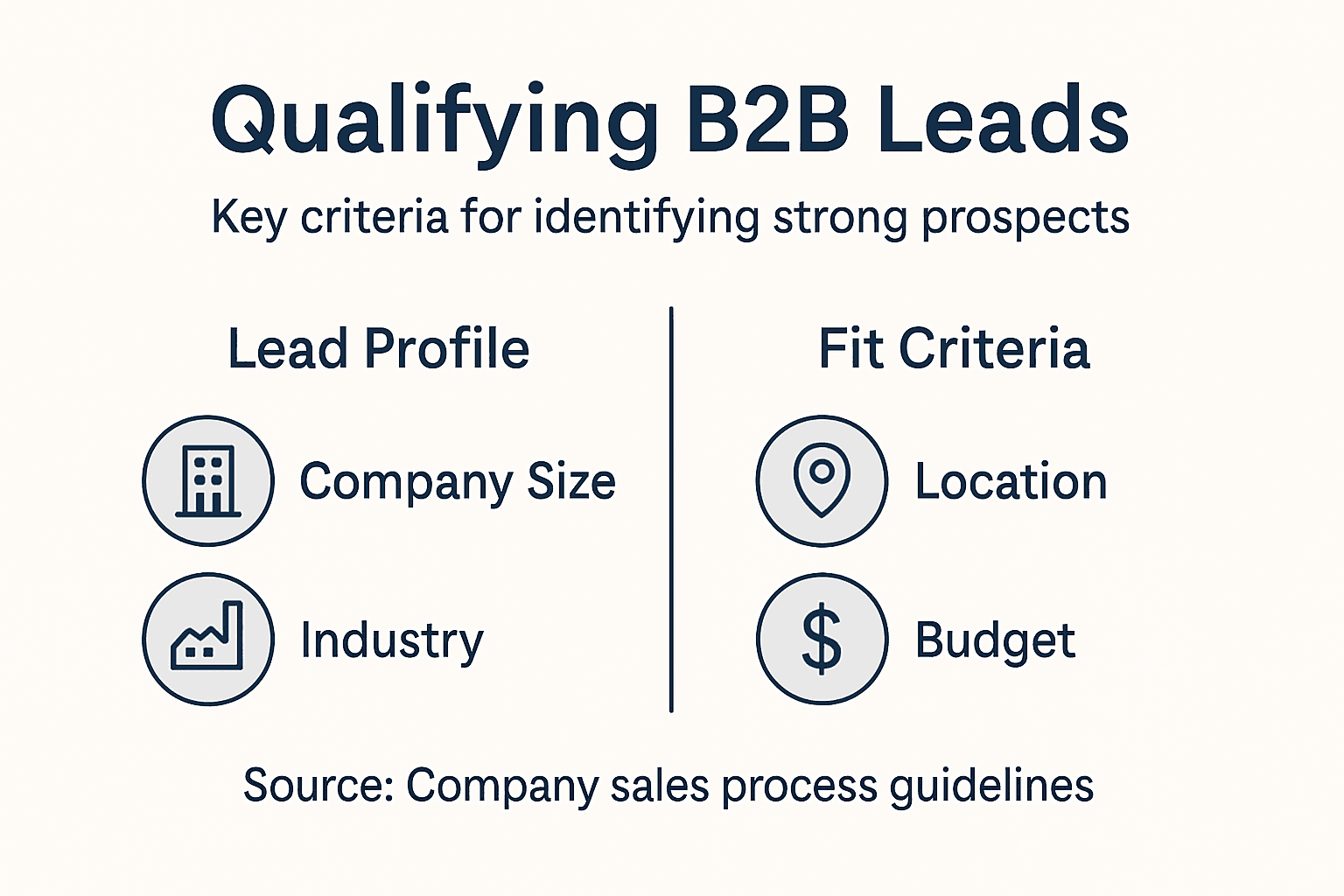
Pro tip: Start by clearly defining what qualifies as a lead for your specific business (company size, industry, location, revenue range), then measure which lead sources consistently produce prospects who actually close, so you can double-down on what works.
Key Types and Methods for B2B Leads
B2B leads come in different forms depending on how you generate them and what stage of the buying journey they’re in. Understanding these distinctions helps your sales team prioritize which prospects to contact first and which approach will work best. Inbound leads arrive because someone on your target company’s team actively sought you out, researched your solution, or requested information. These typically convert faster because they already recognize a need. Outbound leads come from your team’s direct efforts like cold calling, email campaigns, or personalized outreach to companies matching your ideal customer profile. Outbound leads require more nurturing but let you control who you target and when. Account-based marketing (ABM) leads focus on a specific high-value company where you’ve identified multiple decision-makers and contacts. Rather than casting a wide net, you create customized campaigns for each target account. Referral leads come from existing customers, partners, or network connections who introduce you to prospects they know. These typically have the highest close rates because they come pre-qualified by someone the prospect trusts.
Your lead generation methods should align with how your target buyers actually make decisions. Content marketing positions your company as a knowledgeable resource by publishing guides, case studies, webinars, and articles that address your prospects’ challenges. When done well, content attracts prospects who are researching solutions and establishes credibility before your sales team even makes contact. Email marketing allows you to reach specific decision-makers with personalized messages highlighting how your solution solves their particular problems. The key is segmentation and relevance rather than broadcasting generic messages to everyone on a list. Social media outreach lets you identify prospects, engage with their content, and start conversations on platforms like LinkedIn where B2B decision-makers actually spend time. You can also use LinkedIn’s targeting to identify prospects matching specific job titles, industries, or company sizes. Direct outreach through verified contact data involves using targeted lead generation tactics to reach decision-makers with phone calls or personalized messages based on accurate company information and verified contact details. Many Netherlands-based sales teams leverage quality data providers to ensure they’re reaching actual decision-makers rather than outdated or incorrect contacts. Partnerships and integrations involve collaborating with complementary companies or industry associations that already have relationships with your target customers.
What separates high-performing B2B lead generation from mediocre efforts is understanding your buyer personas deeply enough to identify which prospects actually have the pain points your solution solves. A software company selling to manufacturers needs to know not just the company size and industry, but also which departments suffer from the problem, which title typically owns the buying decision, and what success looks like for them. This knowledge shapes everything from which leads you pursue to how you position your value. Personalization at scale means using data and technology to tailor your outreach so it feels relevant to each prospect rather than generic. When a prospect receives an email mentioning their specific company challenges or recent company milestones, they’re more likely to respond. Consistent follow-up and nurturing recognizes that B2B sales cycles take time. A prospect might not be ready to buy when you first contact them, so maintaining the relationship until they’re ready matters. This is where email sequences, periodic check-ins, and relevant content become valuable.
The most effective approach combines multiple methods based on what works for your specific market and company type. A B2B software company might use content marketing to attract leads, social media to build awareness, email sequences to nurture prospects, and direct outreach using quality contact data to accelerate deals with high-potential accounts. A B2B services firm might rely more heavily on referrals and partnerships combined with strategic outreach to identified target companies. Track which methods produce leads that actually convert to customers, not just leads that look promising initially. This data-driven approach lets you allocate your budget and time toward the methods generating genuine revenue growth rather than vanity metrics.
Here’s a quick comparison of major B2B lead types and their impact on sales:
| Lead Type | How It’s Generated | Pros for Sales Teams | Typical Conversion Speed |
|---|---|---|---|
| Inbound | Prospect initiates contact | Highly motivated prospects | Fast |
| Outbound | Direct outreach by sales | Full control of targeting | Moderate |
| ABM (Account-based) | Tailored campaigns by account | Deep engagement with buyers | Slow to moderate |
| Referral | Introduced via networks | Pre-qualified + trusted | Very fast |
Pro tip: Choose 2-3 lead generation methods that align with how your target buyers prefer to be reached, test them for 3-4 months with consistent effort, then double down on whichever produces the highest quality leads based on conversion rate and deal size.
How the B2B Lead Generation Process Works
The B2B lead generation process is a structured approach that combines sales and marketing to attract prospects, qualify them, and move them through your sales pipeline toward a purchase decision. Rather than a single action, it’s a cycle that repeats continuously. The process starts with awareness and attraction, where you get your company and solution in front of people who might have a need. This happens through content they find online, social media posts they see, email campaigns they receive, or direct outreach from your sales team. The goal at this stage is simply to capture attention from prospects matching your ideal customer profile. Once someone shows interest, they enter the engagement phase where you begin building a relationship. This might involve a demo call, a consultation, or continued conversations about their specific challenges. You’re learning more about their situation while they’re learning whether your solution could help. During this phase, you’re also qualifying the lead by assessing how much authority they have to make buying decisions, how urgent their need is, and whether your solution is truly the right fit. A prospect with high authority, immediate pain, and clear fit is a hot lead worth your sales team’s immediate attention. Someone with potential but lower urgency is a warm lead to nurture over time.

The lead qualification step is critical because it prevents your sales team from wasting time on prospects unlikely to buy. Cold leads are early-stage prospects who may not even realize they have a problem your solution solves, or they’re aware of a need but haven’t started evaluating options. These require patient nurturing through education and relationship-building. Warm leads have identified a problem and begun researching solutions but haven’t decided between vendors. Your job is to position your solution and build confidence that you’re the best choice. Hot leads are actively evaluating you and are close to a purchasing decision. These get immediate attention from your best sales people. This classification helps you allocate resources efficiently. You might use marketing automation to nurture cold and warm leads with relevant content while your sales team focuses on hot leads that are ready to buy. As you execute B2B outreach strategies, tracking which leads move through these stages reveals what’s actually working versus what’s not.
Once leads are qualified and engaged, the conversion phase begins where your sales team actively works to close deals. This involves addressing remaining objections, answering detailed questions about pricing and implementation, and negotiating contract terms. The sales and marketing teams must stay aligned during this phase. Marketing should provide sales with the information about each prospect’s specific challenges and interests so sales can tailor their pitch. After a customer signs, the process doesn’t end. Customer retention and expansion involves ensuring they achieve success with your solution so they renew their contract and potentially buy additional products or services. These existing customers also become your best source of referrals and case studies, feeding new leads back into your pipeline. The entire cycle from awareness to retention typically takes months in B2B, not weeks, so patience and consistent execution matter far more than sporadic bursts of effort.
What makes this process work in practice is tracking metrics at each stage. You need to know how many prospects enter your pipeline, how many move from cold to warm, how many convert from warm to hot, and ultimately how many close. If leads are getting stuck at one stage, you’ve identified a bottleneck to fix. Maybe your content isn’t resonating so prospects stay cold. Maybe your sales team lacks tools or skills to effectively qualify prospects. Maybe your follow-up is inconsistent so warm leads cool down. Without measurement, you’re just hoping your efforts work. With data, you can continuously improve your process. Most successful B2B sales teams test different approaches, measure the results, and invest more heavily in what produces the highest-quality leads and fastest conversions.
Pro tip: Map out your actual lead generation process from start to finish, assign responsibility for each stage, establish metrics for how leads move between stages, and review performance monthly to identify where most prospects are dropping off so you can prioritize improvements.
Legal Compliance and Data Validation Essentials
When you’re building a B2B lead generation strategy, the data you use to identify and contact prospects carries legal obligations you cannot ignore. Whether you’re operating in the Netherlands or targeting European markets, regulations like GDPR (General Data Protection Regulation) govern how you collect, store, and use personal information about decision-makers and company contacts. GDPR requires explicit consent before contacting individuals via email or phone for marketing purposes in many cases, and it gives people the right to know what data you hold about them and to request deletion. Beyond GDPR, Dutch data protection laws and sector-specific regulations may apply depending on your industry. If you’re cold calling, you need to understand telemarketing regulations that restrict when and how you can reach prospects. The penalties for non-compliance are substantial, ranging from significant fines to reputational damage that makes prospects less willing to engage with you. More importantly, operating legally builds trust. Prospects are more likely to respond to outreach from companies they perceive as trustworthy and professional.
Data validation is the foundation of legal compliance because inaccurate data leads to compliance violations. If your contact list includes wrong email addresses or outdated phone numbers, you might be contacting the wrong person entirely, violating their privacy or annoying them with irrelevant messages. Validation processes ensure high data quality through automated checks that detect errors and inconsistencies before you use the data. For B2B lead generation, this means verifying that the contact information you’re using actually belongs to the person you think it does, that their job title and company are current, and that you have legitimate business reasons to reach out to them. Many data providers in the Netherlands now use screen recordings to show exactly how they gathered and verified contact information, providing transparency about data quality. When selecting a data provider, ask whether they validate information against multiple sources, how frequently they update their databases, and what their accuracy guarantees are. Poor data validation leads to bounced emails, disconnected phone numbers, and contacts who are no longer at the company you’re trying to reach.
Implementing a compliance program for your lead generation efforts requires establishing clear processes and documentation. You need to document why you’re contacting specific prospects, what data you’re collecting about them, how long you’re storing it, and how you’re protecting it. Create a record of consent if you’re relying on consent as your legal basis for outreach. Maintain a do-not-contact list for people who request removal from your outreach efforts and honor those requests immediately. Train your sales team on compliance requirements so they understand they cannot ignore privacy regulations or harvest contact information from sources that don’t provide consent. Schedule regular audits of your lead database to identify outdated information and remove people who no longer fit your target audience. If you’re purchasing leads from external providers, verify their compliance practices and get written agreements that they’ve obtained information legally. This isn’t bureaucratic busywork. These procedures protect your company from legal exposure and ensure your team is spending time reaching out to prospects who actually want to hear from you.
Data security is another critical compliance component. If you’re storing contact information, email addresses, and details about prospects’ companies and needs, you have a responsibility to protect that data from unauthorized access or breach. This means using encrypted storage, restricting who in your organization can access prospect data, and implementing password protection on any systems containing lead information. If you experience a data breach, you have legal obligations to notify affected individuals and may need to report it to regulatory authorities. Cybersecurity might seem disconnected from lead generation, but it’s part of the same compliance picture. A prospect whose personal information you handled carelessly and then lost to hackers will never trust you or your company again. The combination of accurate data, transparent processes, and strong security sends the message that you’re a professional organization worth doing business with.
Pro tip: Before launching any B2B outreach campaign, audit your data source for accuracy, document your legal basis for contacting each prospect, and establish a process for handling opt-out requests immediately, which turns compliance from a burden into a competitive advantage.
The table below summarizes common legal and data validation steps for compliant lead generation:
| Compliance Area | Key Action | Business Benefit | Common Risk if Ignored |
|---|---|---|---|
| Data Validation | Verify contact details | Fewer bounced emails | Targeting wrong contacts |
| Documentation | Record consent/status | Reduces legal exposure | GDPR violation fines |
| Data Security | Use encrypted storage | Builds prospect trust | Breach damages reputation |
Common Pitfalls and Maximizing Cold Outreach
Cold outreach is one of the most direct ways to fill your sales pipeline, but it’s also where many teams waste enormous amounts of time and energy. The biggest pitfall is failing to understand your prospect’s actual needs before reaching out. You send a generic email to a hundred companies saying your solution is great, and you’re shocked when the response rate is near zero. Real prospects don’t care that your product exists. They care whether it solves a specific problem they’re experiencing right now. Before you contact anyone, research that company. Look at their recent news, their job postings, their LinkedIn activity. Identify which departments might benefit from your solution and what challenges they’re likely facing. A personalized message referencing something specific about their company gets opened and responded to far more often than a template blast.
Another common mistake is poor timing and inconsistent follow-up. You send one email and never follow up, assuming silence means no interest. In reality, your prospect was probably busy, your email landed in their overcrowded inbox, or they’re still evaluating options. Sales research shows it takes multiple touches before most cold prospects respond. But many teams don’t have a structured follow-up process, so leads go cold. You also reach out at the wrong time of day or week, reducing the chance they’ll see your message when they’re in a frame of mind to engage. Additionally, relying on outdated contact information wastes outreach efforts before you even begin. If your prospect list is months or years old, you’re calling people who changed jobs, reached disconnected numbers, or sending emails to inboxes they no longer use. This damages your sender reputation and frustrates prospects who receive irrelevant messages at the wrong address. Quality data that’s recently validated is foundational to successful cold outreach.
To maximize cold outreach, shift from generic blasts to targeted, account-based approaches that focus on a smaller number of high-value prospects with personalized messaging. Rather than contacting 500 companies with the same email, identify 50 companies that truly fit your ideal customer profile and spend time crafting customized messages for each. Mention their industry challenges, reference their specific company size or recent company moves, show that you’ve actually researched them. This approach has dramatically higher response rates because prospects feel like you’re speaking directly to them, not reading from a script to thousands of people. Combine your personalized cold outreach with relevant content marketing and social presence so prospects can research you before responding. They see your LinkedIn posts about industry trends, they download your guide about solving a problem they face, and by the time your cold email arrives, you’re not a complete stranger. Your outreach becomes the final touch that moves them toward a conversation rather than the first confusing contact.
Building the right sequences and measuring results separates successful cold outreach teams from those spinning their wheels. Create a structured sequence where your first email is short and personalized, your second email (sent 3-5 days later) provides additional value like a relevant resource or case study, and your third and final email asks directly if they’d like a brief conversation. Space these out so you’re not bombarding them. Track metrics like open rates, response rates, and conversion rates so you can see which approaches work. Maybe your emails to software companies have a 15% response rate while emails to manufacturing companies sit at 3%. This tells you to refocus on software companies or rethink your messaging for manufacturers. Most teams never look at this data, so they keep doing what doesn’t work. The teams that dominate cold outreach treat it like an experiment where every campaign teaches them something that improves the next one. They test different subject lines, different message lengths, different follow-up timing, and they measure what actually moves prospects toward conversations.
Pro tip: Pick one specific target company segment, research five companies deeply, personalize your outreach completely, send a three-email sequence with 3-5 days between touches, and measure response rates carefully before scaling to larger lists.
Turn Your Lead Generation Strategy Into Predictable Growth With Verified Data
Struggling to find qualified B2B leads that truly match your ideal customer profile can waste precious time and drain your sales resources. This article highlights the challenge of sourcing high-quality, well-targeted leads that accelerate your sales pipeline without guesswork. If your sales team is tired of generic outreach and slow conversion rates cold outreach that lacks personalization or outdated contact information sabotaging your efforts DataFacilitator.com offers a powerful solution tailored for outbound sales and market expansion.
Discover how our Netherlands-based platform delivers highly targeted, verified B2B contact lists designed for exactly the kind of strategic lead generation described here. By focusing on accuracy transparency and compliance DataFacilitator lets you build a predictable pipeline with legal and validated data you can trust. Explore our We handle the leads, you close the deals. – DataFacilitator collection to get quality leads that fit your specific country region or industry niche. Ready to say goodbye to generic prospecting and hello to a data-driven growth engine Visit https://datafacilitator.com now and take control of your sales pipeline.
Frequently Asked Questions
What is B2B lead generation?
B2B lead generation is the process of identifying, attracting, and qualifying potential business customers who have shown interest in your products or services. It focuses on engaging decision-makers within organizations rather than individual consumers.
How does B2B lead generation drive growth for sales teams?
B2B lead generation feeds the sales pipeline with qualified prospects who match your ideal customer profile, allowing sales teams to forecast revenue accurately and scale their growth intentionally without wasted efforts on unqualified leads.
What are the main types of B2B leads?
The main types of B2B leads include inbound leads (prospects initiate contact), outbound leads (direct efforts by sales), ABM leads (targeted campaigns for specific companies), and referral leads (introduced by existing customers or partners).
Why is personalization important in B2B lead generation?
Personalization enhances engagement by tailoring outreach to address specific challenges or needs of each prospect, increasing the likelihood of a response and building trust before a sales conversation.