


B2B sales teams across Europe often discover that finding the right contacts is more than a numbers game. Effective cold outreach relies on a nuanced process that blends research, strategic segmentation, and ongoing validation. In this guide, you will uncover how thoughtful contact sourcing goes beyond simple data collection, helping you avoid common myths, improve conversion rates, and stay compliant with evolving regulations for real market growth.
Table of Contents
- Defining B2B Contact Sourcing and Common Myths
- Key Types of B2B Contact Data Sources
- How B2B Contact Sourcing Works in Practice
- Legal Compliance and Data Privacy Challenges
- Cost Structures and Pay-Per-Result Models
- Avoiding Common Risks and Data Quality Mistakes
Key Takeaways
| Point | Details |
|---|---|
| B2B Contact Sourcing is Strategic | It involves systematically identifying, collecting, and verifying professional contact information for targeted business engagement. |
| Quality Over Quantity | Effective B2B contact sourcing prioritizes accurate, validated data over large volumes of contacts to enhance outreach efficiency. |
| Continuous Data Validation is Essential | Regular data validation and cleansing are crucial to maintaining high-quality B2B contact lists and ensuring compliance with privacy regulations. |
| Understand Legal Compliance | Companies must navigate complex legal requirements related to data protection to mitigate risks in B2B contact sourcing. |
Defining B2B Contact Sourcing and Common Myths
B2B contact sourcing represents a strategic process of identifying, collecting, and verifying professional contact information for potential business customers or sales prospects. Unlike consumer marketing, B2B contact sourcing requires precise targeting and deep understanding of organizational structures. B2B data acquisition involves more complex decision-making processes that extend beyond simple transactional interactions.
Many professionals misunderstand B2B contact sourcing as a straightforward data collection exercise. However, successful sourcing demands nuanced approaches that recognize the human elements driving business relationships. Key myths persist about this process, including misconceptions that automated tools can replace strategic research or that quantity trumps quality in contact databases. In reality, effective B2B contact sourcing requires sophisticated segmentation, detailed verification, and understanding of specific industry communication channels.
The fundamental components of robust B2B contact sourcing include comprehensive research, precise targeting, and continuous data validation. Sales teams must focus on collecting verified contact information that includes not just email addresses and phone numbers, but also professional roles, organizational hierarchies, and potential decision-maker insights. Accurate contact sourcing enables more personalized outreach strategies that significantly improve conversion rates and reduce wasted communication efforts.
Pro tip: Always validate contact information through multiple sources and implement regular database cleansing to maintain high-quality B2B contact lists.
Key Types of B2B Contact Data Sources
B2B contact data sources represent a complex ecosystem of information channels that enable businesses to identify and connect with potential customers. B2B data encompasses multiple categories including firmographic, technographic, demographic, and detailed contact information. These diverse sources provide comprehensive insights that help sales and marketing teams develop targeted engagement strategies.
The primary types of B2B contact data sources can be categorized into three main groups: internal data collection systems, external third-party providers, and public databases. Internal sources typically include customer relationship management (CRM) systems, historical sales records, and direct interactions with existing clients. External providers offer specialized databases with pre-verified professional contact information, while public sources like professional networking platforms and industry directories provide supplementary verification and additional context.
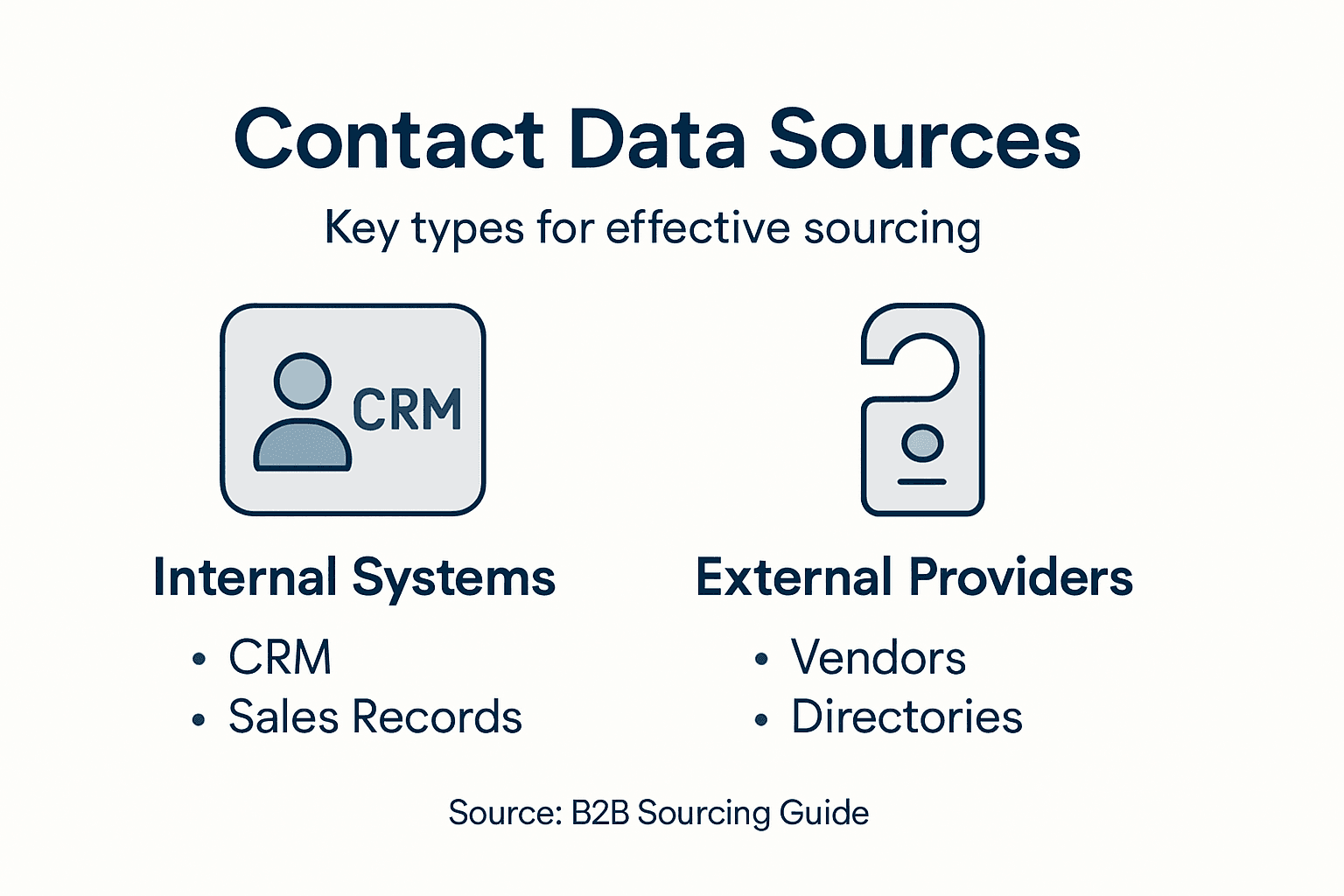
Each data source requires careful evaluation to ensure accuracy and compliance with data protection regulations. Sophisticated B2B contact sourcing strategies involve cross-referencing multiple sources, continuously updating information, and implementing rigorous validation processes. Sales teams must prioritize data quality over quantity, focusing on obtaining precise, actionable contact details that enable meaningful business communications and relationship building.
Pro tip: Implement a regular data hygiene protocol that cross-validates contact information from at least three independent sources to maintain high-quality B2B contact databases.
Here’s a summary of common B2B contact data sources and their unique benefits:
| Data Source Type | Main Advantage | Key Consideration |
|---|---|---|
| Internal Systems | High accuracy from direct data | Limited to existing relationships |
| Third-Party Providers | Access to large, verified pools | Ongoing cost and licensing issues |
| Public Databases | Supplementary context and leads | Requires manual verification |
How B2B Contact Sourcing Works in Practice
B2B contact sourcing operates through a sophisticated, multi-layered approach that combines strategic research, technological tools, and targeted communication methods. Buyers’ sourcing strategies reveal complex organizational behaviors that go far beyond simple data collection. Successful sourcing requires understanding the intricate relationships between potential business contacts, their organizational structures, and the specific communication channels most likely to generate meaningful engagement.
The practical implementation of B2B contact sourcing typically involves several critical stages. First, companies define their ideal customer profile by identifying specific firmographic characteristics such as company size, industry, geographic location, and technological infrastructure. Next, researchers utilize a combination of digital tools, professional networks, and specialized databases to identify and verify potential contact points. This process includes cross-referencing information from multiple sources, validating email addresses, confirming job titles, and assessing the potential relevance of each contact to the organization’s sales objectives.

Advanced B2B contact sourcing strategies also incorporate sophisticated segmentation techniques that go beyond basic demographic information. Sales teams now leverage technographic data, analyze digital footprints, and use predictive analytics to understand potential customer behaviors and preferences. This approach allows for more nuanced targeting, enabling businesses to create highly personalized outreach strategies that significantly improve conversion rates and reduce wasted communication efforts.
Pro tip: Develop a dynamic scoring system that continuously evaluates and ranks potential B2B contacts based on multiple engagement indicators, ensuring your sourcing efforts remain precise and adaptable.
Legal Compliance and Data Privacy Challenges
B2B contact sourcing requires navigating a complex landscape of legal and regulatory requirements that vary significantly across different jurisdictions. Cross-border data privacy challenges highlight the intricate legal complexities businesses must address when collecting and using professional contact information. These regulations demand rigorous approaches to data protection, consent management, and individual privacy rights.
The primary legal considerations in B2B contact sourcing include adherence to data protection regulations like the General Data Protection Regulation (GDPR) in Europe, the California Consumer Privacy Act (CCPA) in the United States, and similar frameworks in other regions. Companies must implement robust mechanisms for obtaining explicit consent, ensuring data accuracy, providing transparent information about data usage, and establishing clear protocols for data storage and deletion. This requires sophisticated technological and administrative controls that go beyond simple data collection practices.
Technological solutions play a critical role in addressing data privacy challenges. Organizations must invest in advanced encryption technologies, implement strict access controls, and develop comprehensive data anonymization strategies. These technical safeguards must be complemented by organizational policies that prioritize ethical data handling, maintain comprehensive audit trails, and create transparent mechanisms for individuals to understand and control their professional contact information.
Pro tip: Develop a comprehensive data governance framework that includes regular privacy impact assessments, ongoing staff training, and automated compliance monitoring systems to mitigate legal risks in B2B contact sourcing.
Cost Structures and Pay-Per-Result Models
B2B contact sourcing has evolved to embrace more sophisticated pricing mechanisms that align vendor compensation with actual client outcomes. Dynamic pricing models represent a fundamental shift from traditional fixed-price structures toward more flexible, value-driven approaches. These innovative models enable businesses to pay precisely for the results they receive, reducing financial risk and increasing transparency in contact data procurement.
Pay-per-result models typically involve structured pricing tiers based on specific delivery metrics such as verified contact accuracy, relevance to target industries, or successful contact rate. Companies can choose pricing configurations that might include flat rates for verified contacts, graduated pricing based on contact quality, or performance-based pricing where payment is contingent upon achieving predefined engagement thresholds. This approach allows organizations to optimize their investment by directly linking expenditure to tangible sales and marketing outcomes.
The implementation of these advanced pricing strategies requires robust technological infrastructure and sophisticated data validation processes. Sales and marketing teams must establish clear performance criteria, develop precise tracking mechanisms, and create comprehensive agreements that define exactly what constitutes a successful contact or lead. This necessitates advanced analytics capabilities, real-time reporting systems, and transparent communication channels between data providers and clients to ensure mutual understanding of performance expectations.
Pro tip: Negotiate pricing models that include multiple validation checkpoints and performance guarantees to ensure you only pay for high-quality, actionable B2B contact data.
The table below compares two typical B2B contact sourcing cost models:
| Pricing Model | Payment Basis | Best For |
|---|---|---|
| Fixed Fee | Pay per database/license | Large, static contact lists |
| Pay-Per-Result | Pay for verified outcome | Measurable, targeted results |
Avoiding Common Risks and Data Quality Mistakes
B2B contact sourcing involves numerous potential pitfalls that can compromise data integrity and significantly impact sales effectiveness. Compliant B2B data requires sophisticated strategies to mitigate risks associated with inaccurate, outdated, or improperly collected contact information. Sales teams must develop comprehensive approaches to identify and prevent common data quality challenges.
The most prevalent risks in B2B contact sourcing include data decay, incorrect contact information, incomplete profile details, and inadequate verification processes. Organizations frequently encounter issues such as outdated email addresses, incorrect job titles, disconnected phone numbers, and incomplete company information. These data quality problems can lead to wasted resources, reduced sales productivity, and diminished outreach effectiveness. Successful mitigation requires implementing rigorous validation protocols, continuous data maintenance, and advanced verification technologies.
Effective risk management in B2B contact sourcing demands a multi-layered approach. This includes establishing robust data collection standards, implementing automated verification systems, conducting regular data audits, and creating clear protocols for updating and maintaining contact information. Sales and marketing teams must develop systematic processes that continuously validate and refresh contact data, utilize multiple verification sources, and maintain strict compliance with data protection regulations.
Pro tip: Develop a quarterly data hygiene protocol that includes automated verification checks, manual spot-checking of contact details, and systematic removal of inactive or unresponsive contacts from your database.
Unlock Accurate B2B Contact Sourcing for Better Sales Results
Struggling with outdated or inaccurate B2B contact data? This article highlights critical challenges like data decay, complex verification, and compliance risks that can stall your outbound sales efforts. At DataFacilitator.com, we understand the importance of precise targeting, continuous validation, and legal compliance in B2B contact sourcing to help you connect with the right decision makers every time.
Explore our tailored B2B lead solutions and experience the difference of verified, segmented contact lists designed for effective cold outreach and market expansion. Don’t waste time on unreliable data. Act now and access high-quality leads on a flexible pay-per-result basis. Visit We handle the leads, you close the deals. – DataFacilitator or start with our main platform to empower your sales team today.
Frequently Asked Questions
What is B2B contact sourcing?
B2B contact sourcing is the process of identifying, collecting, and verifying professional contact information for potential business customers or sales prospects, focusing on precise targeting and understanding organizational structures.
How can businesses improve the quality of their B2B contact data?
To improve B2B contact data quality, businesses should implement rigorous validation protocols, conduct regular data audits, utilize multiple verification sources, and establish systematic processes for updating and maintaining contact information.
What are the key types of B2B contact data sources?
The key types of B2B contact data sources include internal systems (like CRM), external third-party providers (offering verified databases), and public databases (such as networking platforms), each providing different advantages and considerations.
Why is legal compliance important in B2B contact sourcing?
Legal compliance is crucial in B2B contact sourcing to adhere to data protection regulations, ensure privacy rights, and establish transparent protocols for data handling, which helps mitigate legal risks and protect both the organization and individual contacts.