


Cold outreach often feels unpredictable for Sales and Marketing professionals at fast-growing tech startups looking to break into new global markets. The challenge is not just finding potential buyers, but reaching the right ones at the perfect moment. With B2B contact segmentation powered by advanced CRM and machine learning, targeted outreach becomes more strategic and effective. Learn how segmentation helps you build high-quality contact lists that drive meaningful conversations and measurable expansion.
Table of Contents
- What Is B2B Contact Segmentation?
- Key Segmentation Types And Criteria Explained
- How Segmentation Drives Outreach Results
- Personalization, Efficiency, And Cost Benefits
- Compliance, Data Privacy, And Common Pitfalls
Key Takeaways
| Point | Details |
|---|---|
| B2B Contact Segmentation | It’s essential for categorizing business customers for targeted sales and marketing strategies. |
| Segmentation Types | Firmographic, behavioral, and value-based segmentation provide unique insights to optimize outreach approaches. |
| Performance Benefits | Effective segmentation leads to increased lead conversion rates and improved customer relationship management. |
| Compliance Considerations | Businesses must navigate data privacy regulations to ensure ethical marketing practices while implementing segmentation strategies. |
What Is B2B Contact Segmentation?
B2B contact segmentation is a strategic approach to categorizing business customers into distinct groups based on specific characteristics, enabling more targeted and personalized sales and marketing efforts. Unlike generic customer classifications, this method creates precise, actionable customer profiles that help organizations optimize their outreach strategies.
Modern B2B contact segmentation has evolved significantly, moving beyond traditional static firmographic data to incorporate dynamic, real-time insights. Sophisticated segmentation technologies now leverage machine learning and behavioral signals to create more nuanced customer classifications.
Key characteristics used in B2B contact segmentation typically include:
- Company size and revenue
- Industry vertical
- Geographic location
- Technological infrastructure
- Purchasing behavior
- Strategic value to the organization
- Relationship intensity
The primary goal of B2B contact segmentation is to enable businesses to:
- Prioritize high-value customer targets
- Customize communication strategies
- Allocate sales and marketing resources more efficiently
- Predict potential buying behaviors
- Develop more personalized engagement approaches
Pro tip: Start with analyzing your existing customer database to identify natural clustering patterns that can inform your initial segmentation strategy.
Key Segmentation Types and Criteria Explained
B2B contact segmentation encompasses multiple sophisticated approaches designed to classify potential business customers with precision and strategic insight. Comprehensive segmentation strategies consider various dimensions that go beyond simple demographic categorizations, creating nuanced customer profiles that drive targeted marketing efforts.
The primary types of B2B contact segmentation include:
-
Firmographic Segmentation: Categorizing businesses by objective characteristics such as:
- Company size
- Industry vertical
- Annual revenue
- Geographic location
- Organizational structure
-
Behavioral Segmentation: Analyzing customer interactions and purchasing patterns:
- Purchase frequency
- Spending volume
- Product preferences
- Decision-making processes
- Historical engagement levels
-
Value-Based Segmentation: Ranking contacts by their potential economic impact:
- Customer lifetime value
- Strategic alignment
- Potential for long-term partnership
- Profitability metrics
Each segmentation type offers unique insights that help organizations craft more targeted and effective sales strategies. By understanding the nuanced characteristics of different business customer groups, companies can develop highly personalized communication approaches that resonate with specific market segments.

The most sophisticated segmentation models combine multiple criteria, creating dynamic and adaptable customer classifications that evolve with changing market conditions and organizational needs.
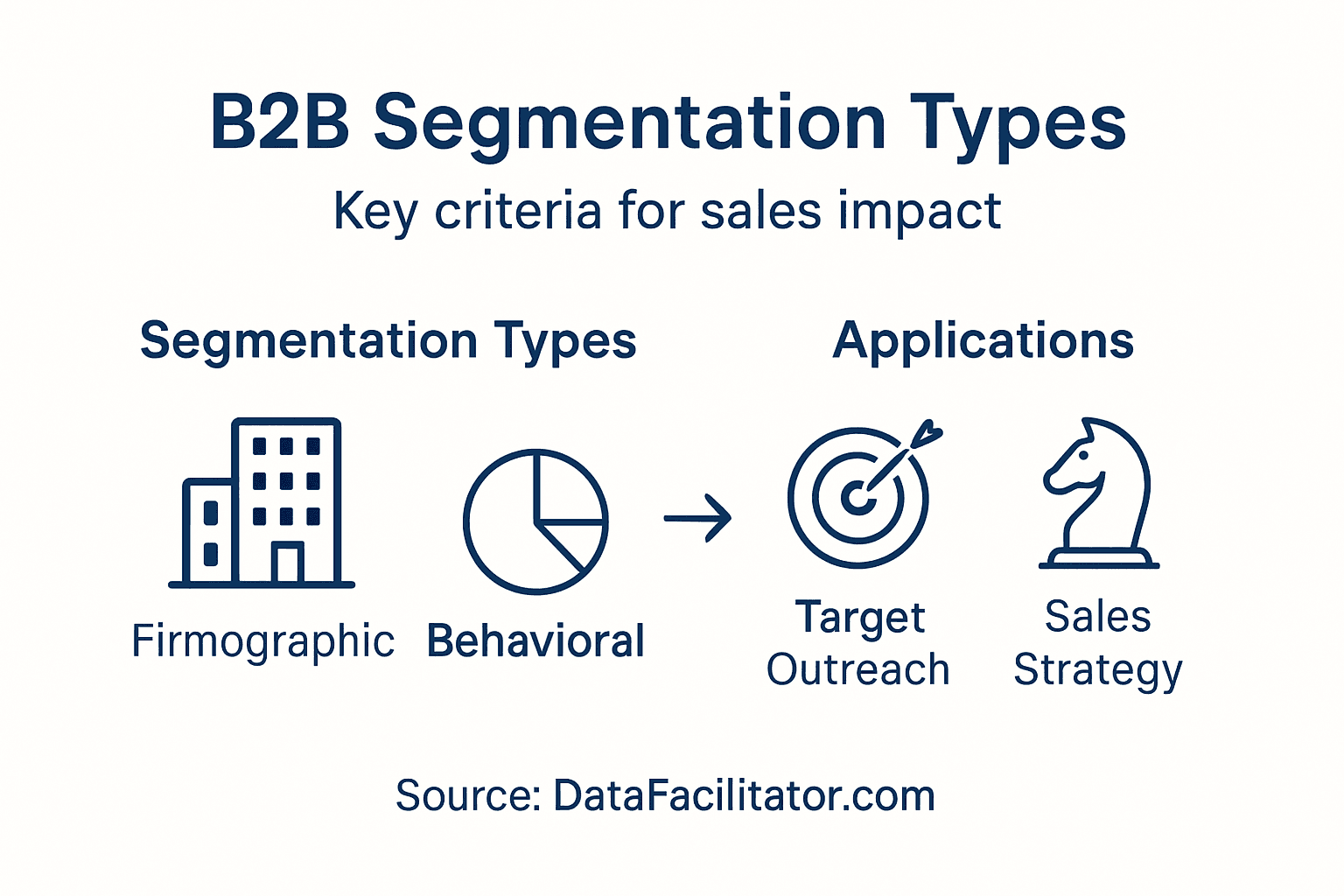
Here’s a comparison of the main B2B segmentation types and their strategic business impacts:
| Segmentation Type | Key Focus Area | Typical Application | Business Impact |
|---|---|---|---|
| Firmographic | Company attributes | Initial market filtering | Broad target identification |
| Behavioral | Customer actions | Campaign personalization | Refined message relevance |
| Value-Based | Economic contribution | Prioritizing accounts | Higher profitability focus |
| Combined Approaches | Multiple dimensions dynamically | Adaptive segmentation modeling | Resilience to market changes |
Pro tip: Regularly update your segmentation criteria and periodically reassess your customer classifications to maintain accuracy and relevance.
How Segmentation Drives Outreach Results
Targeted customer behavior research demonstrates that strategic B2B contact segmentation dramatically transforms outreach effectiveness by enabling precise, personalized communication approaches. This data-driven methodology allows sales teams to move beyond generic messaging and create highly contextual engagement strategies tailored to specific business customer profiles.
Segmentation drives outreach results through several critical mechanisms:
- Precision Targeting: Identifying ideal customer characteristics
- Resource Optimization: Focusing efforts on high-potential segments
- Communication Customization: Crafting resonant messaging
- Predictive Insights: Anticipating customer needs and behaviors
- Performance Tracking: Measuring engagement across different segments
The impact of effective segmentation on outreach results can be quantified across multiple dimensions:
- Increased lead conversion rates
- Reduced customer acquisition costs
- Improved response rates
- Enhanced customer relationship management
- More efficient sales funnel progression
By understanding unique segment characteristics, organizations can develop sophisticated outreach strategies that speak directly to each group’s specific challenges, preferences, and operational contexts. This approach transforms cold outreach from a numbers game into a precision-targeted communication strategy.
This summary highlights how segmentation delivers measurable business value:
| Outcome Area | Result of Effective Segmentation | Long-Term Benefit |
|---|---|---|
| Lead Quality | More qualified prospects | Better sales pipeline health |
| Conversion Rate | Higher close ratio | Accelerated revenue growth |
| Acquisition Cost | Lower expenses per customer | Improved marketing ROI |
| Relationship Management | Deeper client connections | Stronger retention and loyalty |
| Sales Forecasting | Clearer pipeline visibility | More predictable performance |
Segmentation transforms generic sales approaches into personalized, high-impact customer engagement strategies.
Pro tip: Develop dynamic segmentation models that continuously adapt to changing market conditions and customer behaviors.
Personalization, Efficiency, and Cost Benefits
Advanced CRM segmentation technologies revolutionize B2B marketing by enabling unprecedented levels of personalization, operational efficiency, and strategic cost management. By transforming raw contact data into actionable insights, businesses can dramatically improve their sales and marketing performance while simultaneously reducing resource expenditure.
The core benefits of strategic segmentation include:
-
Precise Personalization:
- Tailored communication strategies
- Targeted value propositions
- Customized engagement approaches
-
Operational Efficiency:
- Streamlined sales processes
- Automated targeting mechanisms
- Reduced manual classification workload
-
Cost Optimization:
- Focused resource allocation
- Minimized wasted marketing efforts
- Improved conversion cost ratios
Companies implementing sophisticated segmentation strategies typically experience significant performance improvements across multiple dimensions:
- Increased lead quality
- Higher conversion rates
- Reduced customer acquisition expenses
- More predictable sales outcomes
- Enhanced marketing ROI
Strategic segmentation transforms generic outreach into a precision-driven, cost-effective business growth mechanism.
By leveraging data-driven insights, organizations can create more intelligent, responsive marketing ecosystems that adapt quickly to changing market dynamics and customer preferences.
Pro tip: Invest in continuous data refinement and segmentation model updates to maintain competitive edge and accuracy.
Compliance, Data Privacy, and Common Pitfalls
Data privacy compliance frameworks represent a critical consideration in modern B2B contact segmentation, requiring businesses to navigate complex regulatory landscapes while maintaining effective marketing strategies. Understanding the intricate balance between data utilization and legal requirements is essential for sustainable and ethical business practices.
Key compliance challenges and potential pitfalls include:
-
Regulatory Complexity:
- GDPR requirements
- CCPA regulations
- International data protection standards
-
Data Management Risks:
- Inadequate consent mechanisms
- Poor data quality
- Insufficient documentation
- Lack of transparent data processes
-
Potential Operational Consequences:
- Legal penalties
- Financial sanctions
- Reputational damage
- Loss of customer trust
Businesses must implement comprehensive strategies to mitigate these risks:
- Establish robust data governance protocols
- Conduct regular compliance audits
- Develop transparent data collection processes
- Create clear consent management systems
- Maintain detailed documentation of data usage
Effective B2B segmentation demands a proactive approach to data privacy and regulatory compliance.
By integrating compliance considerations directly into segmentation methodologies, organizations can create more resilient and legally sound marketing frameworks that protect both business interests and customer rights.
Pro tip: Invest in ongoing compliance training and develop a culture of data responsibility within your organization.
Unlock Your Sales Potential with Targeted B2B Contact Segmentation
Struggling to convert cold leads into valuable customers? The article “Why Segment B2B Contacts: Boost Sales Impact” highlights how precise segmentation helps you avoid generic outreach that wastes time and resources. By focusing on firmographic, behavioral, and value-based criteria, you can craft personalized sales messages that resonate deeply with your target audience. Your goal is clear: prioritize high-value contacts and efficiently allocate your sales efforts to increase conversions and reduce acquisition costs.
At DataFacilitator.com, we specialize in delivering verified, segmented B2B contact lists tailored to specific industries, regions, and business needs. Our platform ensures compliance and transparency by validating data before delivery, so you only pay for real leads that boost your pipeline. Whether you want to explore targeted datasets for outbound campaigns or expand into new markets, check out our curated collections at We handle the leads, you close the deals. – DataFacilitator and We handle the leads, you close the deals. – DataFacilitator.
Don’t let unsegmented data hold your sales back. Empower your outreach with accurate segmentation and watch your conversion rates climb. Visit https://datafacilitator.com now to find the perfect targeted B2B contact lists designed to turn cold prospects into loyal customers.
Frequently Asked Questions
What is B2B contact segmentation?
B2B contact segmentation is the process of categorizing business customers into specific groups based on characteristics like company size, industry, and purchasing behavior, enabling targeted marketing efforts.
How does B2B contact segmentation improve sales strategies?
It allows businesses to prioritize high-value customer targets, customize communication strategies, and allocate resources more efficiently, leading to improved outreach results.
What are the main types of B2B contact segmentation?
The main types include firmographic segmentation (based on company characteristics), behavioral segmentation (based on customer interactions), and value-based segmentation (focused on economic impact).
How can segmentation models adapt to changing market conditions?
By combining multiple criteria and regularly updating segmentation strategies, businesses can create dynamic classifications that evolve with shifts in customer behavior and market dynamics.