


Reaching decision-makers in the crowded Dutch business market can feel like a hit-or-miss effort without the right information. Cold outreach demands more than a simple contact list, especially when every conversation counts toward real opportunities. For B2B professionals, working with high-quality lead generation data is the difference between random guessing and a focused, strategic approach that connects with prospects who matter. Discover how quality data transforms sales outreach into an efficient, results-driven process.
Table of Contents
- Defining Lead Generation Data In B2B Sales
- Types Of Lead Generation Data: Key Differences
- How B2B Lead Data Powers Outbound Outreach
- Ensuring Data Quality And Relevance
- Compliance, Privacy, And Common Pitfalls
Key Takeaways
| Point | Details |
|---|---|
| Lead Generation Data | Structured information about potential business prospects is essential for effective B2B sales outreach. |
| Types of Data | Utilizing demographic, firmographic, technographic, and behavioral data allows for targeted prospect identification and engagement. |
| Data Quality | Regular validation and maintenance of lead data are crucial to ensure accuracy and relevance in outreach strategies. |
| Compliance | Understanding and adhering to data privacy regulations is vital for successful and ethical lead generation practices. |
Defining Lead Generation Data in B2B Sales
Lead generation data represents a structured collection of potential business prospects’ information critical for targeted sales outreach and conversion. At its core, B2B lead generation involves identifying business prospects systematically, enabling sales teams to connect with decision-makers who have genuine potential for product or service adoption.
The fundamental components of lead generation data typically include several key elements:
- Company name and industry
- Contact details of decision-makers
- Company size and revenue range
- Geographic location
- Current technology stack
- Potential pain points or business challenges
Effective lead generation data transforms cold outreach from random guesswork into a strategic, targeted approach. By providing granular insights about potential customers, this data allows sales professionals to personalize their communication, increasing the likelihood of engagement and conversion.
B2B lead generation goes beyond simple contact lists. Qualified lead data represents pre-vetted information about prospects who match specific criteria indicating potential interest or buying readiness. This means sales teams receive not just contact information, but context about why a particular company might be an ideal customer.
Pro tip: Validate your lead generation data regularly to maintain accuracy and relevance in your sales pipeline.
Types of Lead Generation Data: Key Differences
Lead generation data comes in multiple distinct categories, each serving unique purposes in the B2B sales ecosystem. Understanding key lead types helps sales teams develop more targeted and effective outreach strategies.
The primary types of lead generation data include:
-
Demographic Data
- Detailed contact information
- Job titles and roles
- Company size and industry
-
Firmographic Data
- Organizational structure
- Annual revenue
- Number of employees
- Geographic location
-
Technographic Data
- Current technology stack
- Software and tools used
- Digital infrastructure
-
Behavioral Data
- Website interactions
- Content engagement
- Previous purchase history
Qualified lead data represents the most valuable segment, combining multiple data points to identify prospects with high conversion potential. These leads are pre-screened and matched against specific ideal customer profile criteria, significantly reducing wasted effort in the sales process.
Each data type offers unique insights that enable more precise targeting. Demographic data provides basic contact information, firmographic data reveals organizational context, technographic data shows technological capabilities, and behavioral data tracks potential buying signals.
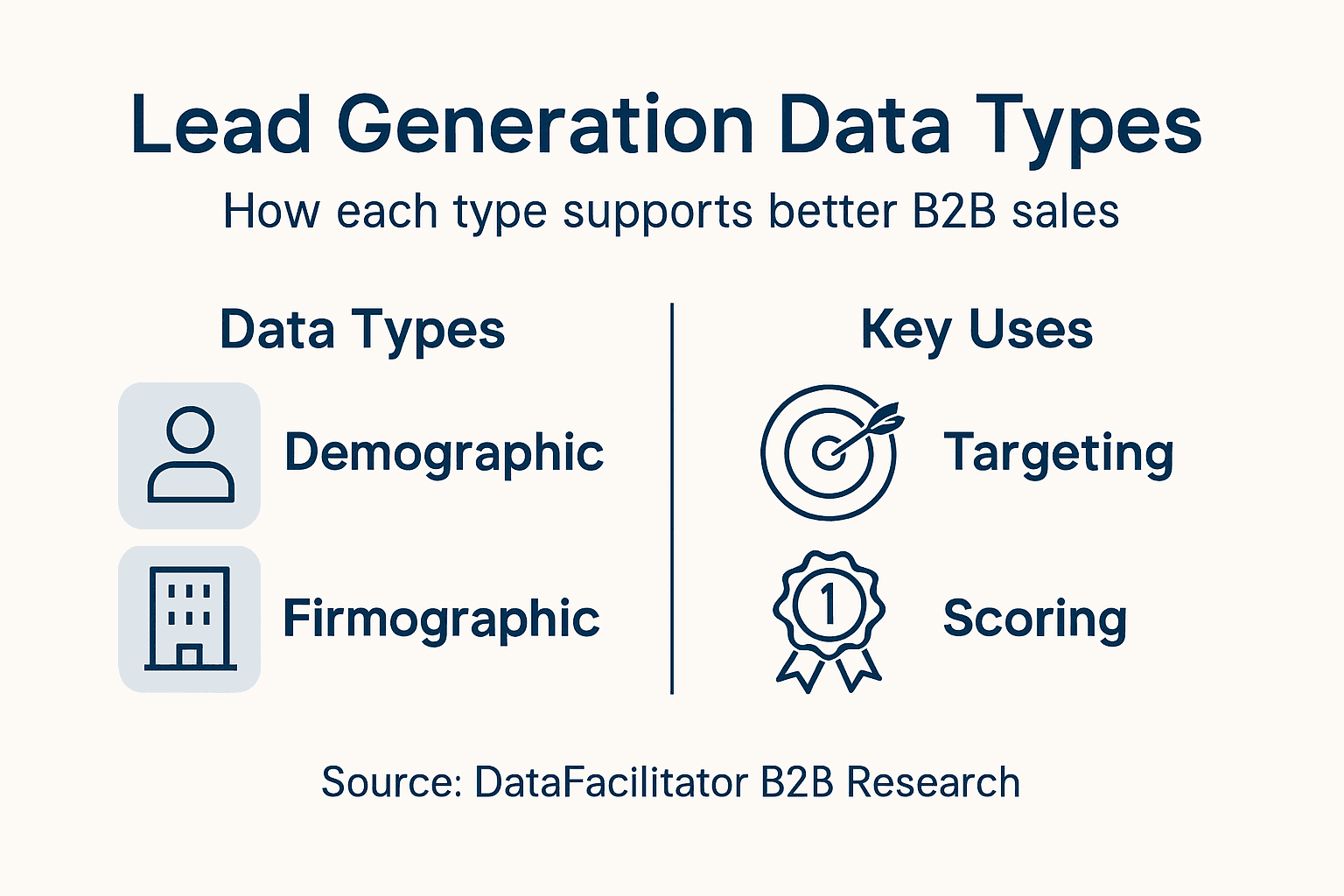
Here’s a comparison of key lead data types and how each enhances sales strategies:
| Data Type | Strategic Value | Unique Application |
|---|---|---|
| Demographic | Pinpoints relevant contacts | Refines outreach lists |
| Firmographic | Identifies organization scope | Prioritizes high-value firms |
| Technographic | Reveals tech adoption level | Tailors product messaging |
| Behavioral | Detects buying intent signals | Times outreach for engagement |
Effective lead generation requires a holistic approach that integrates multiple data types for comprehensive prospect understanding.
Pro tip: Combine different lead data types to create a more nuanced and accurate prospect profile for improved sales targeting.
How B2B Lead Data Powers Outbound Outreach
Outbound lead generation transforms cold outreach through strategic data deployment. Precise lead targeting enables dramatic improvements in sales engagement, allowing teams to connect with the most promising prospects systematically and efficiently.
The key mechanisms by which B2B lead data empowers outbound strategies include:
-
Targeted Prospect Identification
- Filtering leads by industry
- Matching ideal customer profiles
- Prioritizing high-potential accounts
-
Personalized Communication
- Tailoring messaging to specific roles
- Understanding organizational pain points
- Crafting contextually relevant outreach
-
Multi-Channel Engagement
- Coordinating contact across platforms
- Tracking interaction history
- Optimizing communication frequency
Advanced lead data enables sales teams to move beyond generic cold outreach, transforming scattered efforts into precision-targeted campaigns. By integrating multiple data points, organizations can create nuanced understanding of potential customers, significantly improving conversion probabilities.
Effective outbound strategies rely on data quality, transforming raw information into actionable sales intelligence.
Companies leveraging comprehensive lead data can dramatically reduce wasted effort, focusing resources on prospects with genuine potential. The integration of demographic, firmographic, technographic, and behavioral data creates a holistic view that guides more intelligent engagement strategies.
Pro tip: Continuously update and validate your lead data to maintain the highest possible accuracy and relevance in your outbound campaigns.
Ensuring Data Quality and Relevance
Data quality in B2B lead generation determines the effectiveness of sales and marketing strategies. Poor data can undermine entire outreach efforts, causing wasted resources and missed opportunities for meaningful business connections.
Key components of maintaining high-quality B2B lead data include:
-
Accuracy
- Verifying contact information
- Eliminating duplicate records
- Cross-referencing multiple sources
-
Completeness
- Ensuring comprehensive profile details
- Filling potential information gaps
- Tracking data comprehensiveness
-
Timeliness
- Regularly updating contact information
- Monitoring company changes
- Removing outdated records
-
Consistency
- Standardizing data entry formats
- Maintaining uniform data representation
- Implementing validation rules
Data integrity requires continuous monitoring and proactive management. Organizations must develop systematic approaches to collect, validate, and refresh lead information, preventing degradation that can compromise sales intelligence.
Maintaining data quality is not a one-time task but an ongoing strategic commitment that directly impacts business performance.
Successful B2B organizations implement robust data governance frameworks that combine technological solutions with human oversight. Automated verification tools, regular data audits, and clear data management protocols help ensure the ongoing relevance and reliability of lead generation datasets.

Below is a summary of effective practices for maintaining lead data quality in B2B sales:
| Practice | Description | Business Impact |
|---|---|---|
| Quarterly Data Audits | Systematic review of all records | Prevents errors and outdated info |
| Automated Verification | Tech-driven data checks | Improves accuracy and saves time |
| Cross-Source Matching | Validation from multiple sources | Reduces risk of unreliable leads |
| Team Training | Staff education on protocols | Ensures consistent data standards |
Pro tip: Implement a quarterly data validation process to systematically clean and update your lead generation database.
Compliance, Privacy, and Common Pitfalls
Compliant lead generation requires understanding the complex legal landscape surrounding B2B data acquisition and usage. Sales teams must navigate intricate regulations designed to protect business and individual privacy while maintaining effective outreach strategies.
Common compliance challenges in B2B lead generation include:
-
Data Collection Restrictions
- Obtaining explicit consent
- Documenting permission trails
- Respecting opt-out requests
-
Privacy Regulation Compliance
- GDPR requirements
- California Consumer Privacy Act
- International data transfer rules
-
Data Storage Security
- Encryption standards
- Access control protocols
- Regular security audits
-
Consent Management
- Transparent data usage policies
- Clear communication of data purposes
- Providing easy opt-out mechanisms
Regulatory frameworks create significant complexity for B2B sales teams. Each jurisdiction maintains unique requirements that demand meticulous attention to detail, potentially exposing organizations to substantial financial and legal risks for non-compliance.
Successful B2B data strategies balance aggressive lead generation with rigorous legal and ethical standards.
Navigating these challenges requires a proactive approach. Companies must invest in comprehensive compliance training, implement robust data governance protocols, and develop systematic processes for continuous legal and regulatory monitoring.
Pro tip: Consult legal professionals specializing in data privacy to develop a comprehensive compliance strategy tailored to your specific business needs.
Unlock B2B Sales Success with Precision Lead Generation Data
If you are struggling with finding accurate, verified, and targeted lead data to power your outbound sales and cold outreach, you are not alone. The challenges of managing qualified lead data, ensuring data quality, and maintaining compliance can slow your sales momentum. That is why harnessing comprehensive and reliable B2B contact lists, complete with firmographic, technographic, and behavioral insights, is essential for closing more deals and growing your pipeline effectively.
Discover tailored solutions designed to eliminate guesswork from your prospecting. At DataFacilitator, we specialize in providing scalable, compliant, and pay-per-result verified leads so your sales team only pays for actual business contacts delivered. Visit our B2B Leads Collection to explore lead lists crafted to your specific industry, geography, and business niche.
Don’t let outdated or incomplete data stall your sales outreach. Experience the power of consistently updated, highly segmented company data with We handle the leads, you close the deals. – DataFacilitator. Take control of your B2B lead generation today by visiting https://datafacilitator.com and start turning qualified leads into real business opportunities now.
Frequently Asked Questions
What is lead generation data in B2B sales?
Lead generation data is a structured collection of information about potential business prospects that aids sales teams in targeted outreach and conversion efforts. It includes details like company names, contact information, and pain points relevant to the sales process.
Why is qualified lead data important for sales teams?
Qualified lead data represents pre-vetted information about prospects that match specific criteria indicating interest or readiness to buy. This enhances sales efforts by reducing wasted outreach and increasing the likelihood of conversions.
What types of lead generation data should B2B businesses focus on?
B2B businesses should focus on several types of lead generation data, including demographic, firmographic, technographic, and behavioral data. Each type provides unique insights to refine targeting and improve sales strategies.
How can businesses ensure the quality and relevance of their lead data?
Businesses can ensure lead data quality by regularly validating contact information, maintaining completeness, keeping data up-to-date, and ensuring consistency across records. Implementing systematic data governance practices is also crucial for ongoing data integrity.