


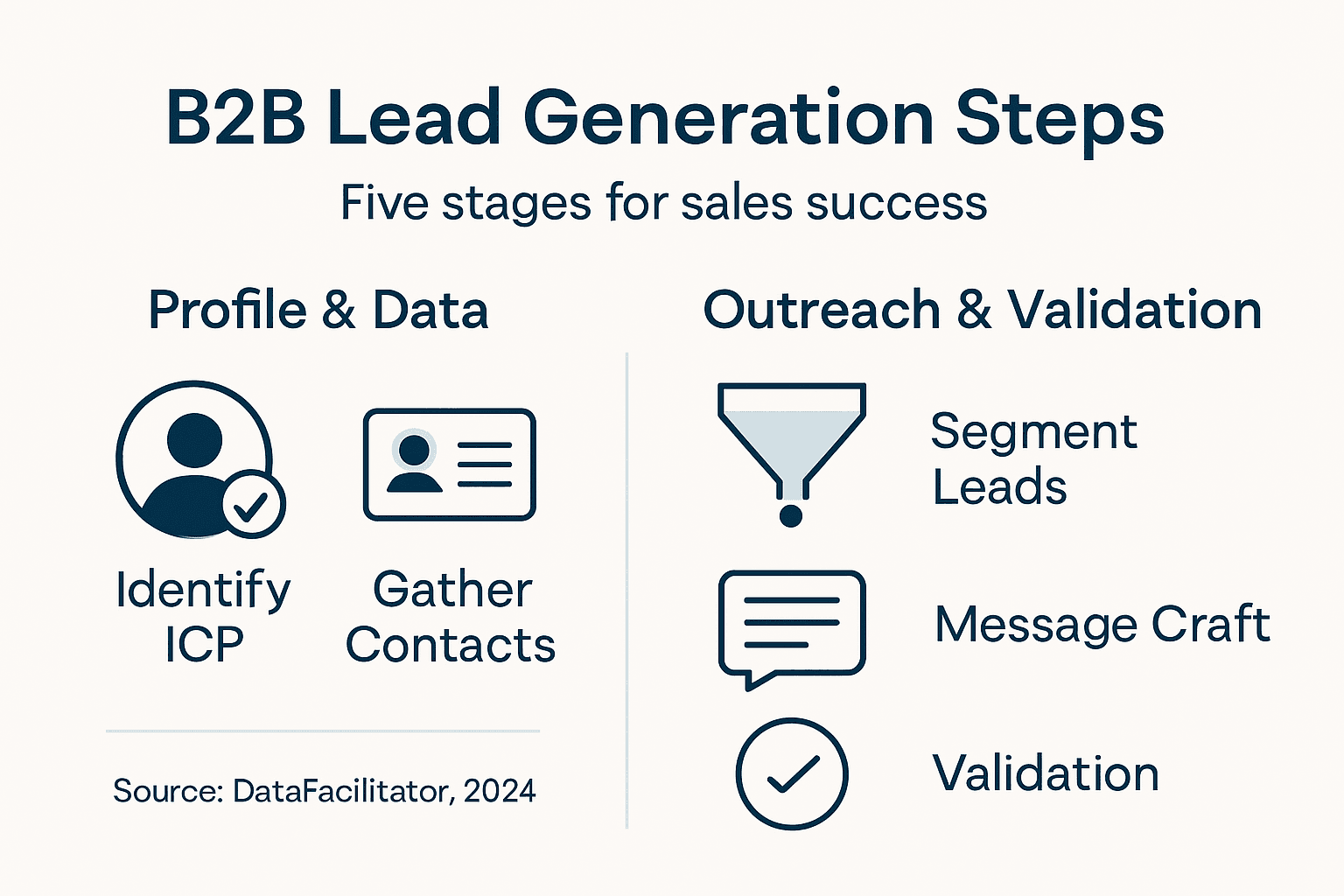
Finding the right companies to target can feel overwhelming when every cold outreach campaign demands precise results and measurable growth. For B2B sales and marketing managers across Europe, defining the companies most likely to become valuable long-term clients is the first step toward consistently stronger outcomes. By focusing on an ideal customer profile backed by verified contact data and strategic segmentation, you can set the stage for more productive conversations and lasting partnerships.
Table of Contents
- Step 1: Define Your Ideal B2B Customer Profile
- Step 2: Select Verified Targeted Contact Data
- Step 3: Segment Leads For Outreach Effectiveness
- Step 4: Craft Compelling Cold Outreach Messaging
- Step 5: Verify Data Quality And Campaign Readiness
Quick Summary
| Main Insight | Explanation |
|---|---|
| 1. Define Your Ideal Customer Profile | Create a detailed blueprint of your target companies to focus sales efforts effectively and acquire high-value accounts. |
| 2. Select Verified Contact Data | Use accurate and relevant contact information that aligns with your ideal customer profile to enhance outreach precision. |
| 3. Segment Leads for Targeted Outreach | Break down contacts into meaningful categories to improve the efficiency and impact of your sales strategies. |
| 4. Craft Compelling Outreach Messaging | Personalize messages to address specific challenges and showcase your value proposition to capture attention. |
| 5. Verify Data Quality Regularly | Implement a robust process for ongoing validation of contact data to maintain accuracy and reliability in outreach efforts. |
Step 1: Define your ideal B2B customer profile
Defining your ideal customer profile (ICP) is a strategic foundation that helps your B2B sales team target and acquire high-value accounts with precision. The goal is to create a detailed blueprint of the companies most likely to become loyal, profitable customers.
To build a robust ICP, start by analyzing your existing customer data through a systematic approach. Gartner recommends using predictive analytics to identify high-value accounts based on key characteristics. Here are the critical components to consider:
- Company Size: Determine the ideal employee count and annual revenue range
- Industry Vertical: Specify the most responsive industry sectors
- Geographic Location: Define target regions or markets
- Technological Infrastructure: Identify compatible technology stacks
- Business Maturity: Outline the growth stage of target companies
Collect both quantitative and qualitative insights by collaborating closely with your sales and customer success teams. They can provide nuanced perspectives about which customer attributes correlate with long-term value and retention.
The most effective ICPs go beyond basic demographics and capture behavioral patterns that signal potential customer fit.
During this process, distinguish between your ICP (company-level characteristics) and buyer personas (individual decision-maker profiles). While related, these are distinct strategic tools for targeted outreach.

Here is a quick reference summarizing the differences between ICPs and buyer personas:
| Strategic Tool | Focus Area | Typical Use Case |
|---|---|---|
| Ideal Customer Profile (ICP) | Company-level fit criteria | Target account selection |
| Buyer Persona | Individual decision-maker qualities | Tailoring outreach messaging |
Pro tip: Regularly review and update your ideal customer profile every six months to ensure it remains aligned with evolving market dynamics and your company’s growth trajectory.
Step 2: Select verified targeted contact data
Selecting verified targeted contact data is a critical step in building an effective B2B sales outreach strategy that ensures you reach the right decision makers with precision and reliability. Your goal is to acquire high-quality contact information that aligns perfectly with the ideal customer profile you’ve already defined.
When sourcing contact data, focus on finding precise B2B contact sourcing strategies that guarantee accuracy and relevance. Key criteria for selecting contact data include:
- Verification Status: Prioritize recently validated contact information
- Data Completeness: Seek profiles with comprehensive company and individual details
- Relevance: Match contacts directly with your ideal customer profile
- Decision Maker Level: Target contacts with actual purchasing authority
- Industry Specificity: Ensure contacts represent your target vertical markets
Careful data selection requires a strategic approach that goes beyond simple list purchasing. Evaluate potential data sources based on their validation processes, update frequency, and compliance with data protection regulations.
Not all contact data is created equal. The quality of your outreach depends entirely on the precision of your initial data selection.
Consider leveraging multiple data sources and cross-referencing information to build the most comprehensive and accurate contact lists possible. This approach minimizes the risk of outdated or incorrect contact information that can derail your sales efforts.
Pro tip: Invest in dynamic data sources that provide real-time updates and verification, ensuring your contact database remains current and actionable.
Step 3: Segment leads for outreach effectiveness
Segmenting your B2B leads is a strategic approach that transforms generic contact lists into targeted, high-potential prospect groups. By breaking down your contacts into precise, meaningful categories, you dramatically improve the efficiency and impact of your sales outreach efforts.
To create meaningful lead segments, implement strategic B2B list segmentation techniques that go beyond basic demographic categorization. Your segmentation strategy should consider multiple critical dimensions:
- Company Size: Differentiate leads by employee count and annual revenue
- Industry Vertical: Group contacts by specific sector and market characteristics
- Technological Maturity: Categorize based on existing technology infrastructure
- Growth Stage: Segment companies by startup, scaling, or enterprise phases
- Purchase Readiness: Classify leads by their potential buying signals and engagement level
Successful segmentation requires a nuanced approach that combines quantitative data with qualitative insights. Analyze each segment’s historical conversion rates, typical sales cycles, and potential lifetime value to refine your targeting strategy.
Effective lead segmentation is not about creating more categories, but about identifying the most meaningful distinctions that drive sales performance.
Consider developing custom scoring models that weight different segmentation criteria based on your specific business context. This approach allows for more dynamic and responsive lead prioritization that adapts to changing market conditions.
Pro tip: Regularly revisit and recalibrate your segmentation models every quarter to ensure they remain aligned with evolving market dynamics and your company’s strategic objectives.
Step 4: Craft compelling cold outreach messaging
Crafting compelling cold outreach messaging is an art that transforms generic communication into targeted, personalized connections that capture potential clients’ attention and spark meaningful business conversations. Your messaging must cut through the noise of overcrowded inboxes and demonstrate immediate value to your prospects.
Develop strategic outbound lead generation approaches that focus on creating messages which are concise, relevant, and tailored to each specific segment. Your cold outreach messaging should incorporate these critical elements:
- Personalization: Reference specific company challenges or recent achievements
- Value Proposition: Clearly articulate the unique solution you offer
- Relevance: Align message with the recipient’s industry and business context
- Brevity: Keep communication succinct and focused
- Social Proof: Include subtle references to successful client outcomes
Structure your messaging around a clear, compelling narrative that addresses the potential client’s specific pain points. Avoid generic templates and focus on creating a connection that feels genuine and thoughtful.
Cold outreach success hinges not on the volume of messages sent, but on the precision and relevance of each communication.
Consider developing multiple message variants for different audience segments, allowing you to test and refine your approach continuously. This adaptive strategy ensures your messaging remains dynamic and responsive to market feedback.
Pro tip: Create a messaging matrix that maps different communication styles to specific industry segments, enabling more targeted and nuanced outreach strategies.
Step 5: Verify data quality and campaign readiness
Verifying data quality and campaign readiness is a critical checkpoint that ensures your B2B outreach efforts are built on accurate, actionable information. This step involves rigorous validation of your contact data and comprehensive assessment of your campaign’s strategic alignment.
Understand the importance of B2B data validation to minimize wasted resources and maximize potential conversion rates. Your verification process should encompass multiple critical dimensions:
- Contact Accuracy: Confirm email addresses, phone numbers, and job titles
- Company Information: Validate organizational details and current status
- Data Recency: Ensure contact information is current and up-to-date
- Compliance Check: Verify adherence to data protection regulations
- Technical Validation: Test email deliverability and contact responsiveness
Conducting a comprehensive data quality audit involves more than simple surface-level checks. You need to develop a systematic approach that combines automated verification tools with manual review processes.
Data quality is not a one-time task but an ongoing commitment to maintaining the integrity of your sales intelligence.
Implement a multi-stage validation process that includes automated verification, cross-referencing with multiple sources, and periodic manual reviews to maintain the highest standards of data accuracy.
The table below summarizes key advantages of data validation methods for B2B campaigns:
| Validation Method | Main Advantage | Example Action |
|---|---|---|
| Automated Tools | Fast, scalable verification | Bulk email checks |
| Manual Review | Detects nuanced errors | Human review of contact accuracy |
| Cross-Referencing | Confirms information consistency | Checking data across sources |
Pro tip: Create a data validation workflow that includes quarterly comprehensive audits and real-time verification protocols to ensure continuous data reliability.
Unlock Precise B2B Lead Generation With DataFacilitator
Struggling to define your ideal customer profile or to secure verified, relevant contact data for your outbound campaigns Understand that targeting the right decision makers with accurate, segmented data is key to B2B sales success. This guide highlighted challenges like lead segmentation, data validation and crafting cold outreach messages that truly resonate. These are the exact areas where DataFacilitator.com shines by delivering highly targeted, compliant B2B contact lists tailored by region industry and company size—saving you time and eliminating guesswork.
Ready to amplify your sales results Discover how We handle the leads, you close the deals. – DataFacilitator empowers sales teams with real-time verified leads that align perfectly with your ideal customer profile. Visit DataFacilitator.com now to explore scalable data solutions and unlock growth opportunities tailored to your market. Don’t wait for leads to find you Start engaging the right prospects today and transform your outbound outreach into measurable business wins.
Frequently Asked Questions
What is an Ideal Customer Profile (ICP) in B2B sales?
An Ideal Customer Profile (ICP) is a detailed description of the type of companies most likely to become valuable customers. To create an ICP, analyze existing customer data and identify key characteristics, such as company size, industry, geographic location, and technological infrastructure.
How do I select verified targeted contact data for my outreach?
To select verified targeted contact data, prioritize sources that guarantee accuracy and relevance. Ensure that the contact information is recently validated, complete, and matches the criteria outlined in your Ideal Customer Profile, focusing on decision-makers who have purchasing authority.
What are the best practices for segmenting leads in a B2B sales strategy?
Best practices for segmenting leads include categorizing contacts by company size, industry, technological maturity, growth stage, and purchase readiness. Implement these segmentation strategies to tailor your outreach efforts and improve conversion rates while ensuring continuous alignment with market dynamics.
How can I craft compelling cold outreach messages?
To craft compelling cold outreach messages, focus on personalization, clearly articulate your value proposition, and reference the recipient’s specific challenges. Make your communication succinct and relevant to capture attention and stimulate engagement, ideally maintaining a length that fits within a few brief paragraphs.
What steps should I take to verify data quality before launching a B2B campaign?
Before launching a B2B campaign, verify data quality by confirming the accuracy of contact details, ensuring information is current, and checking compliance with data protection regulations. Implement a multi-stage validation process, including automated checks and manual reviews, to enhance the reliability of your data.
How often should I update my Ideal Customer Profile?
You should review and update your Ideal Customer Profile every six months to ensure it reflects any changes in your company’s offerings and market conditions. Regular updates will help maintain alignment with your sales strategy and improve targeting effectiveness.